Get Full Government Meeting Transcripts, Videos, & Alerts Forever!
Get email alerts on the Pensions topic
No spam. Unsubscribe anytime.
County association urges sustained employer contributions to address PSPRS legacy debt
Summary
A County Supervisors Association representative told Cochise County supervisors the association is pressing state pension managers and legislators to prioritize paying down legacy PSPRS and EORP liabilities and to keep employer contribution rates elevated to avoid larger long-term costs.
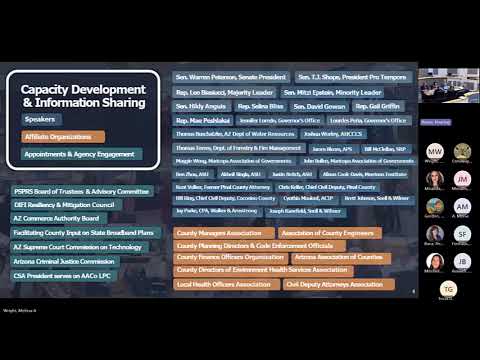
The County Supervisors Association (CSA) representative told the Cochise County Board of Supervisors that the association is focusing on the state public safety retirement systems’ legacy liabilities and will press for policies to accelerate repayment.
The speaker said the association has put resources into monitoring PSPRS (Public Safety Personnel Retirement System) reforms and advising trustees and legislators. “When the PSPRS system is looking at assumption changes, we model and look at what that does to the system. And so we'll provide feedback to help inform some of those assumption changes in a way that helps pay down the debt in a more efficient rate,” the CSA representative said.
Why it matters: counties carry employer obligations for pension plans that were created and amended at the state level, and legacy (closed) tiers carry unfunded liabilities that are not part of ongoing risk pooling. The association warned supervisors that addressing those legacy obligations will require ongoing employer contributions and coordinated state-level policy.
Key details: the presenter distinguished between tiered plans: newer tiers include risk pooling while “tier 1” liabilities are closed legacy debt and must be managed by each jurisdiction. The CSA representative said EORP (the elected officials’ retirement plan) is a pooled liability that also needs a collaborative plan at the state level. The association said counties have contributed “north of a billion dollars” toward paying down legacy pension debt and that it will press to keep employer contribution rates high where a plan is underfunded because “it's cheaper in the long run.”
On who can change contributions, the association noted limits: employee contribution rates are contractual and typically fixed, so counties’ lever is employer contributions. “You can't change his contribution. You can only increase our contributions to the employer,” the CSA representative said.
Discussion vs. action: the presentation outlined advocacy and analysis work rather than any board motion. The CSA representative said the association will bring forward resolutions this fall and that it meets regularly with county managers and finance officers to coordinate policy positions. No formal county vote or policy change occurred during the presentation.
Context and background: the representative reviewed prior litigation and reforms, noting reforms of PSPRS were challenged in court in the 2013–2016 period, which produced substantial liability when courts found some changes diminished vested benefits. The CSA representative said the association uses data analytics and modeling to advise trustees and lawmakers on assumption changes and to avoid repeating past costly outcomes.
What comes next: the CSA representative said the association will refine policy direction at its fall meetings and present resolutions to member counties. Supervisors should expect briefings and potential resolution votes later in the year.