Get Full Government Meeting Transcripts, Videos, & Alerts Forever!
Get email alerts on the Open Meeting Law topic
No spam. Unsubscribe anytime.
Committee received MASC training on conflicts, open-meeting law and public-records practice
Summary
A MASC trainer conducted a session covering chapter 268A conflict-of-interest rules, executive-session reasons and handling, public-comment management, public-records requests, and social-media risks; the trainer urged members to seek ethics-commission guidance before acting and to route public-records requests to the records access officer.
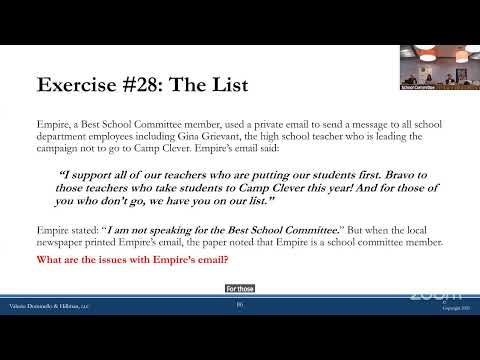
The committee received a training session from the Massachusetts Association of School Committees on conflicts of interest, open-meeting law, public records and related governance duties. The trainer reviewed key points of state conflict law (Chapter 268A), saying members must avoid participating in matters that affect their financial interests or those of immediate family and should file written disclosures with the town clerk when appropriate. The trainer urged members to “always ask before you act” and to consult the state ethics commission for guidance on potential conflicts. On open-meeting law, the presenter explained posting requirements (48 hours excluding weekends/holidays), that gatherings without deliberation are not meetings, and that members must avoid serial communications that effectively create deliberation outside a posted meeting. The trainer emphasized that public-comment rules should be enforced consistently (for example, 20 minutes total and three minutes per speaker if that is the policy) and cautioned about social-media interactions that can create the appearance of deliberation. On public records, members were told to direct requests to the district’s records-access officer rather than responding individually; the trainer noted minutes for open sessions must be provided within 10 calendar days and executive-session minutes require a review process before disclosure. The trainer also reviewed executive-session purposes (personnel, litigation, collective bargaining, security) and the need for roll-call votes to enter executive session and a chair statement of purpose.