Get Full Government Meeting Transcripts, Videos, & Alerts Forever!
Get email alerts on the Housing topic
No spam. Unsubscribe anytime.
Committee debates major housing changes: ADU sizes, density calculations and 'stacked flat' bonuses
Summary
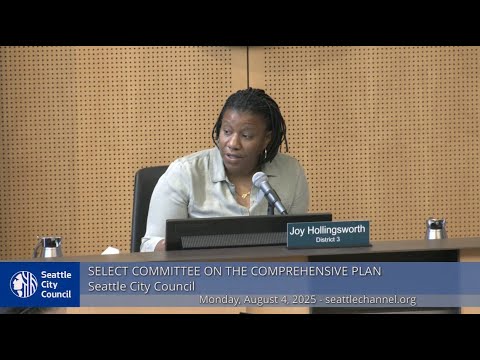
Seattle’s Select Committee on the Comprehensive Plan on Aug. 4 considered multiple housing amendments that would raise ADU size caps, exempt ADUs from density counting, expand affordable- and social-housing bonuses, and increase 'stacked flat' FAR and density under several competing options.
Seattle’s Select Committee on the Comprehensive Plan on Aug. 4 considered a broad set of housing amendments that would change how small-lot housing, accessory dwelling units (ADUs), and mid-density "stacked flat" projects are regulated and incentivized.
Council President Nelson framed his package as incentives to increase housing production: "When given the choice between a carrot or a stick, I'm a carrot person," he told the committee, describing bonus-based measures that trade development allowances for affordable units or other public benefits.
Key housing items presented by central staff included: - ADU size and density: proposals would increase maximum ADU sizes in some cases from a 1,000-square-foot cap to 1,200 or up to 1,500 square feet on certain legacy-owner lots near frequent transit (amendments 55, 57). Several amendments would exempt ADUs from floor-area-ratio (FAR) or density calculations so ADUs would not count toward maximum units per lot (amendments 56, 58). - Affordable-housing and social-housing bonuses: multiple amendments would expand or create development bonuses in neighborhood-residential and multifamily zones, broaden eligibility to social housing (public development authority projects), and permit reduced or no parking requirements for qualifying low-income or social-housing developments (amendments 60–64, 71). - Stacked-flat incentives: the committee reviewed several competing proposals to raise FAR and density for stacked-flat projects. Options ranged from modest increases (1.2 to 1.4 FAR) to larger changes (up to 1.6 or 1.8 FAR, and in some proposals up to 2.0 for projects that meet tree-retention or green-factor thresholds). Amendments also proposed adjusting lot-size thresholds and lot-coverage limits to broaden eligibility (amendments 88–92). - Accessibility and family-sized units: staff presented incentives for projects that include larger (three-bedroom) family units or greater accessibility (type A units), tying those features to bonus FAR or exemptions from density limits (amendments 78, 79).
Councilmembers emphasized policy trade-offs: expanding physical capacity through FAR or density can accelerate housing production but raises questions about infrastructure, transit capacity and environmental review. Central staff reiterated that the combined effect of council changes will determine whether a SEPA addendum or supplemental EIS is required.
What was not decided: the committee did not vote on any of the housing-specific amendments. Members said they would work with colleagues and staff to negotiate consolidated substitute language before September.
Ending: The Aug. 4 briefing framed a broad menu of housing policy tools — ADU reform, density-count exemptions, affordable- and social-housing bonuses, and stacked-flat incentives linked to family-sized units or tree retention — that the council will refine during the public-comment period and committee negotiation ahead of September votes.