Get Full Government Meeting Transcripts, Videos, & Alerts Forever!
Get email alerts on the Trees topic
No spam. Unsubscribe anytime.
Council committee hears competing tree-protection proposals in Seattle comp-plan briefing
Summary
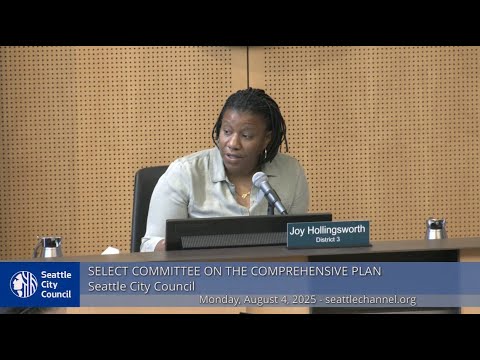
The Select Committee on the Comprehensive Plan on Aug. 4 heard several competing amendments aimed at strengthening Seattle’s tree protection rules, including proposals to use a tree’s drip line versus a fixed 6-foot protection radius and to tie preservation to development incentives.
The Select Committee on the Comprehensive Plan on Aug. 4 heard several competing amendments aimed at strengthening Seattle’s tree protection rules in the city’s comprehensive plan and implementing legislation.
Central staff described two contrasting approaches introduced by councilmembers. "Amendment 105 would set the tree protection area for all trees to be a 6 foot radius from the trunk of a tree," council central staff Liz Schwoodson told the committee. In contrast, "Amendment 106 would instead define a tree protection area as the drip line of a tree and remove authority for the SDCI director to waive tree protection or modify tree protection areas," Schwoodson summarized.
Councilmember Ray Strauss and others proposed a suite of related changes that would increase incentives to preserve trees: requirements to plant at least one tree per 2,500 square feet of lot area (amendment 100), reductions in setbacks or other development-flexibility measures in exchange for tree preservation (amendment 104), and a proposal to require retention of tier 1 and tier 2 trees within 5 feet of a corner of a property (amendment 103). Several members also proposed linking tree retention to other benefits: multiple amendments would allow greater floor-area-ratio (FAR) or height bonuses for projects that retain tier 1 trees or a specified number of tier 2 trees (amendments 91–94), and at least one amendment would mandate a parking-waiver for residential projects that maintain a tier 2 tree (amendment 101).
Councilmember Rivera and others framed tree protection as part of climate resilience and requested approaches that balance tree preservation with housing needs. Rivera said she had worked with residents and with former councilmember Moore on tree-protection language and that the amendments attempt to allow both density and trees to coexist.
What was not decided: the committee received the competing proposals but took no votes on any tree-specific amendment. Central staff and councilmembers noted the need for further technical review (including how tree-protection rules interact with development standards, fire separation, and allowable density) and said they would work to reconcile competing approaches before September.
Clarifying details from the briefing: staff said proposed tree rules include new point or planting requirements, a minimum planting area for small, medium and large trees, and proposed thresholds that would trigger development incentives if trees are preserved. Several amendments would also change setback rules, amenity-area calculations, and allowable lot coverage when trees are protected.
Next steps: the tree proposals will be among amendments posted for the 30-day public-comment period; councilmembers said they expect to negotiate which versions move forward before the Sept. 12 public hearing and committee votes in mid-September.
Ending: The meeting left multiple competing tree-preservation approaches on the table — fixed-radius protection, drip-line protection and incentive-linked retention — with staff and councilmembers planning technical follow-up and negotiation prior to final votes.