Get Full Government Meeting Transcripts, Videos, & Alerts Forever!
Get email alerts on the Comprehensive Plan topic
No spam. Unsubscribe anytime.
Seattle committee opens public review of 106 comprehensive-plan amendments
Summary
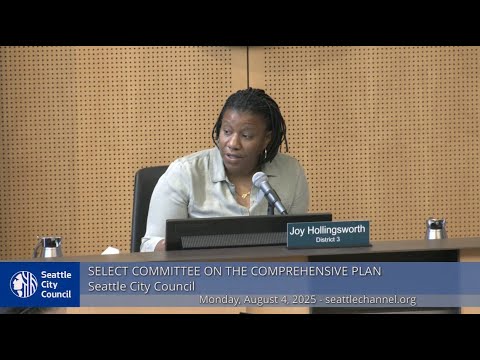
Seattle’s Select Committee on the Comprehensive Plan began a formal briefing on Aug. 4, 2025, laying out 106 proposed amendments to two pending council bills that would update the city’s comprehensive plan and implement new state rules referred to in the meeting as House Bill 11 10.
Seattle’s Select Committee on the Comprehensive Plan began a formal briefing on Aug. 4, 2025, laying out 106 proposed amendments to two pending council bills that would update the city’s comprehensive plan and implement new state rules referred to in the meeting as House Bill 11 10. Chair Joy Hollingsworth, chair of the committee, opened the session and said the amendments would be posted for a 30-day public comment period and that the committee intends to hold a public hearing on Sept. 12.
The committee’s central staff said the 106 amendments are split evenly: 53 proposed changes to the comprehensive plan bill and 53 to the implementing legislation. Liz Schwoodson, council central staff, briefed the committee and walked members through the amendments by topic, element and map rather than by author to make comparison easier. "There are 106 amendments that we're gonna walk through today," Schwoodson said during the presentation.
Why it matters: The package touches core city policy — housing capacity and types, neighborhood centers and maps, tree protection, parking rules, and public-safety planning — and will guide land-use decisions for the next 20 years if adopted. Committee members described competing goals in the amendments: increasing housing supply and affordability, protecting trees and neighborhood character, and addressing infrastructure and public-safety needs.
Central themes identified during the briefing included: expanding housing options (accessory dwelling units and “stacked flats” bonuses, social-housing incentives), tree-preservation measures and competing definitions of tree-protection areas, map changes proposing dozens of new or adjusted neighborhood centers (including multiple options for Magnolia and other neighborhoods), and proposals to reduce or eliminate some parking requirements. Several members also highlighted public-safety language and park proposals specific to neighborhoods such as Queen Anne.
Committee procedure and timeline were emphasized repeatedly. Chair Hollingsworth said offices and central staff will work between the briefing and the September meetings to seek consensus packages; members will receive substitute bills in mid-September. The amendments will be posted for 30 days for public comment; the committee’s public hearing is scheduled for Sept. 12 at 9:30 a.m., and the committee expects to vote between Sept. 17–19. Central staff warned that collective changes could trigger additional environmental review under the State Environmental Policy Act (SEPA) depending on the final package.
What was decided at the meeting: the committee adopted the agenda by unanimous consent at the start of the session and received the staff briefing; no final votes on amendments were taken. Multiple councilmembers indicated they would use the month before the public hearing to meet with colleagues and community members to narrow competing proposals.
Next steps: Amendments will be posted for public comment for 30 days. Committee members have scheduled meetings with the chair and staff to negotiate substitute packages. The public hearing is Sept. 12 and final committee votes are expected in the third week of September.
End note: The briefing clarified the scale and scope of proposed changes and set a fast-moving public-review schedule; members and staff repeatedly urged community members to file written comments during the 30-day posting period and to sign up for the Sept. 12 public hearing.