Get Full Government Meeting Transcripts, Videos, & Alerts Forever!
Get email alerts on the Regional Transport Plan topic
No spam. Unsubscribe anytime.
Puget Sound Regional Council outlines Vision 2050 goals, warns of growing local street funding gap
Summary
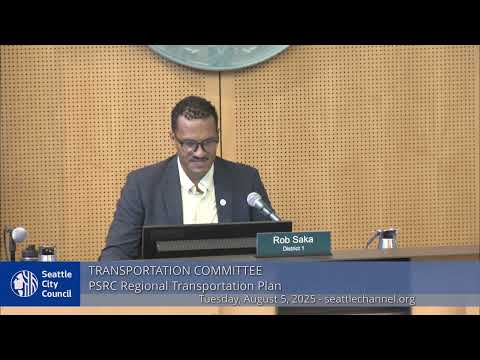
Puget Sound Regional Council Executive Director Josh Brown told the Seattle City Council Transportation Committee on Aug. 5 that Vision 2050 remains the region’s “North Star” for linking land use and transportation planning and that the next regional transportation plan, due in 2026 with a planning horizon to 2050, will be a major update.
Puget Sound Regional Council Executive Director Josh Brown told the Seattle City Council Transportation Committee on Aug. 5 that Vision 2050 remains the region’s “North Star” for linking land use and transportation planning and that the next regional transportation plan, due in 2026 with a planning horizon to 2050, will be a major update.
The update is intended to incorporate local comprehensive-plan project lists, renew emphasis on safety, equity, climate and transit access, and respond to higher-than-anticipated cost escalation. “We have to have this regional transportation plan to unlock the door and tap into accessing all the critical federal transportation funds that the region counts on,” Brown said.
Why it matters: PSRC coordinates planning across cities, counties and transit agencies for the Central Puget Sound region and distributes hundreds of millions of dollars in federal transportation funding biennially. Brown emphasized that maintaining the region’s existing infrastructure consumes the largest share of planned spending and that transit-focused capacity investments account for about 70% of projected capacity dollars in the current plan.
Brown summarized outcomes since the 1990 Growth Management Act and the PSRC reorganization: the region set Vision 2050 goals in 2020 to focus growth in regional centers and transit corridors; as a result, approximately 97% of regional growth now occurs inside the urban growth boundary. “That is by design,” Brown said, pointing to the overlay of growth centers and major transit corridors.
On climate and access: Brown told the committee compact land use, high-quality transit and improved last-mile connections (sidewalks, bike lanes, feeder service) are central regional levers to reduce emissions. “Sometimes when we’re building big expensive transit projects…we should probably be thinking about how to celebrate that last mile sidewalk project or that bike lane to get people to those connections,” he said.
On revenue: Brown said the PSRC’s 2022 plan had a 16% funding gap; the draft for the next plan shows a 21% gap. He said cost escalation and more conservative revenue assumptions — including a smaller, less-flexible state road user charge than previously assumed — are driving the increased gap. “By far, the largest revenue gap in our transportation plan…it is city streets and roadways,” Brown said.
Brown outlined policy options for addressing shortfalls: keep prior (more ambitious) road-user-charge assumptions, seek state flexibility to allow some revenues to fund local projects and transit, or ask the legislature for regional/local add-on revenue authority. He said PSRC staff are presenting options to their Transportation Policy Board and working with member governments on priorities.
Public comment at the start of the meeting tied into the presentation. Holly Gardner thanked the council and SDOT for their work on the Grand Street alley vacation project and described it as a “6 year partnership.” A separate remote commenter, identified as David Haynes, raised safety and enforcement concerns on regional transit and bus-rail transfers in the University District and downtown.
What’s next: PSRC plans to deliver the draft regional transportation plan for adoption in 2026; Brown said the Transportation Policy Board is considering how aggressively to clean up the capacity list of highway projects (for example, removing unfunded or post-2040 projects). The committee received the briefing; no formal action was taken at this meeting.
Ending: Committee members thanked Brown for the briefing and discussed the need for paired regional housing and transportation planning to manage growth and preserve access to transit.