Get Full Government Meeting Transcripts, Videos, & Alerts Forever!
Get email alerts on the Public Safety topic
No spam. Unsubscribe anytime.
University Place police update: staffing increases, school liaison and traffic focus, council asks for crime breakdowns
Summary
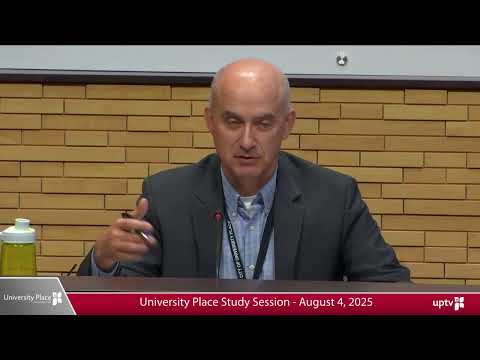
University Place police Chief Patrick Burke gave a public safety update to the City Council on Aug. 4 describing recent staffing increases, new school and community outreach roles, and a plan to add traffic enforcement capacity.
University Place police Chief Patrick Burke gave a public safety update to the City Council on Aug. 4 describing recent staffing increases, new school and community outreach roles, and a plan to add traffic enforcement capacity. Council members pressed for more detailed crime breakdowns, trending data, and metrics the department will use to measure results.
The update matters because the council and voters funded a staffing increase through a local levy; the chief said the additional officers are already affecting overtime, response options and proactive patrols in the city.
Chief Burke summarized staffing and planned additions in the department: “Prior to the levy, we had 16 commissioned officers. In 02/2024, we added 4 officers and the community outreach officer,” he said, adding the department is “tracking November to add 4 more to that to 24 commissioned.” He also said the department planned, in 02/2025, to add three patrol officers (one per shift) and an officer dedicated to traffic enforcement and education.
Burke said increased staffing has delivered several operational changes: lower overtime and improved officer wellness; more options for response and slower, de‑escalatory approaches to incidents; and the ability to backfill when officers are injured. He credited community feedback for shaping proactive patrol locations: residents provided roughly 30 locations over the prior 3–4 months that prompted directed patrols.
On schools, Burke described the school liaison officer added last November. “That partnership is growing. It's good for our students,” he said, noting the liaison spends part of his time at the school district and part supporting patrol. The council asked for clarification; Burke said the liaison uses roughly half his time in the district and half with patrol duties.
The chief showed charts comparing proactive policing, dispatch calls and crime counts from 2020 through mid‑2025 (the 2025 figures covered the first two quarters only). He said some categories — including traffic stops and DUI arrests in certain years — have increased, and he plans a traffic safety officer to focus enforcement and education. When asked about a recent rise in violent‑crime counts, Burke offered to provide a detailed breakdown by incident type and location to inform targeted responses.
Burke discussed non‑crime workloads as well: the community outreach officer, Corey, has taken a lead on homelessness contacts and follow‑up, reducing patrol workload; investigator Chris Coffin has recovered a significant amount of property and was recognized with an award; and officers have been active in regional training and community events such as National Night Out and Coffee with a Cop (scheduled for Oct. 1).
The chief also addressed questions about immigration enforcement. “By state law… we don't have an active role in immigration enforcement,” Burke said, adding the department’s policy is consistent with state law and he could point residents to the relevant RCW for further information.
Council members asked for additional data and follow up. Questions included: a breakdown of which call types drove increases in dispatch calls; more detail on violent crimes and aggravated assaults; whether shoplifting sting operations will resume (Burke said they had not run in 2025 but expected to resume in the fall); tracking of patrol checks (calls not responded to immediately for resource reasons); and whether the department is seeking communications‑system upgrades ahead of county projects. Burke agreed to follow up on requested statistics, including call breakdowns and trend analyses.
Discussion only — there were no formal votes or new ordinances. Several council members complimented the department and said increased staffing is achieving intended results; they also urged continued data sharing so the council can evaluate outcomes as new officers and programs are added.
Clarifying details from the meeting: the chief reported 16 commissioned officers prior to the levy, four added in February 2024 plus a community outreach officer, and plans discussed to add additional commissioned officers in 2024–2025 (transcript references included February 2024 and November additions and a 2025 plan for three patrol officers and a traffic officer); the department used community feedback to identify roughly 30 traffic/enforcement locations in recent months; July 4 enforcement numbers were 51 calls in 2023, 37 in 2024 and 44 in 2025, compared with a 20‑year average in the low 60s.
Next steps: Burke will provide requested breakdowns of dispatch and violent‑crime figures and return with follow‑up data to help shape targeted enforcement and community interventions.