
Wolfeboro ZBA approves variance to reopen Hope House transitional housing at 1618 Lerner Street
Get AI-powered insights, summaries, and transcripts
Sign Up Free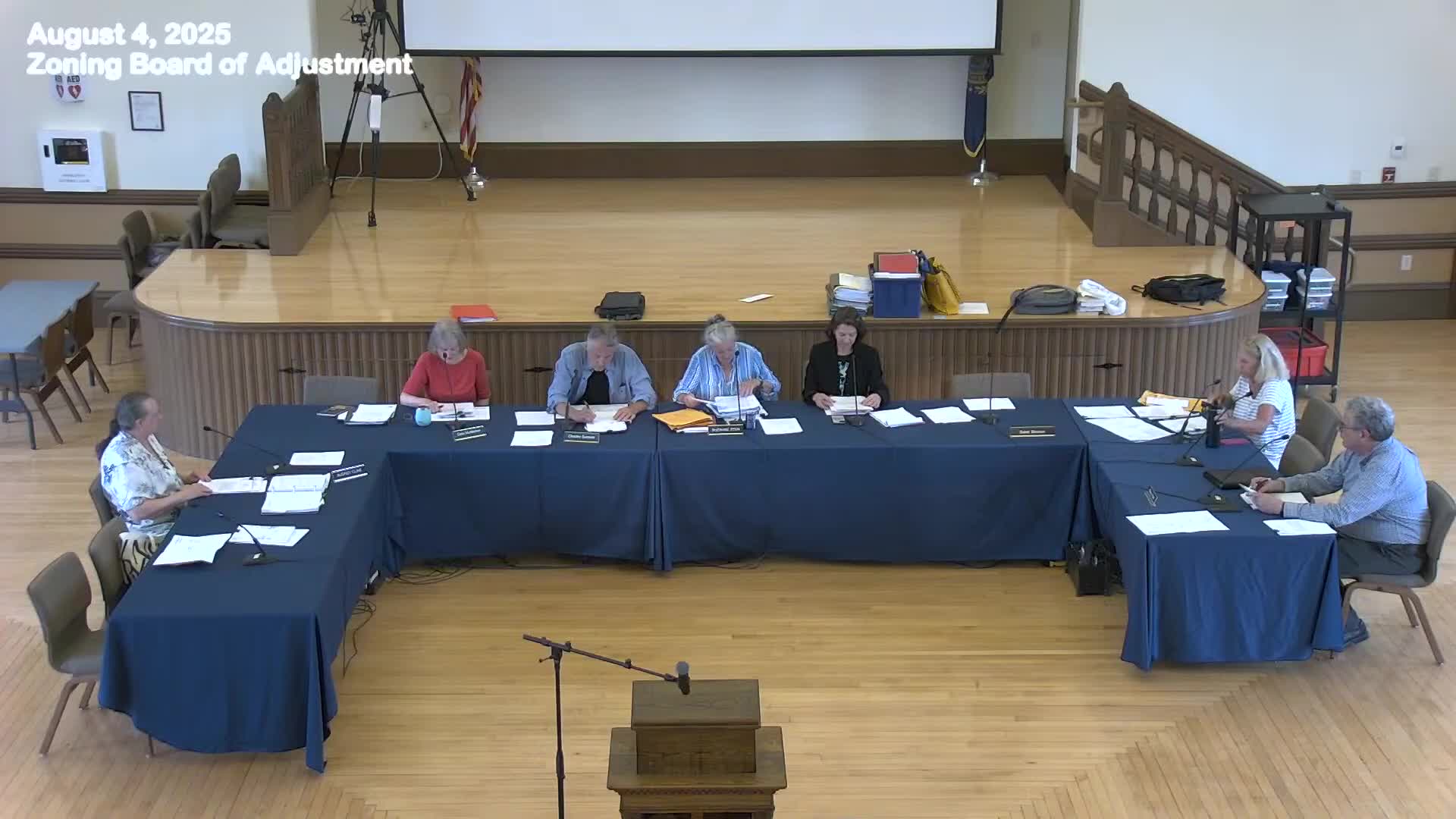
Summary
The Zoning Board of Adjustment unanimously approved a variance to allow the second and third floors of 1618 Lerner Street to be used for temporary transitional housing and services, restoring a use that previously operated at the site.
The Wolfeboro Zoning Board of Adjustment on Aug. — approved a variance allowing the second and third floors of 1618 Lerner Street to be used for temporary transitional housing and comprehensive services for families experiencing homelessness. The motion passed unanimously on a roll-call vote after public comment and deliberation.
The variance, granted for Hope House Holdings Inc., restores a use the board approved in 2016 and which lapsed when the prior operator closed. The approval covers use of the second and third floors for transitional housing, with conditions requiring all applicable federal and state permits and compliance with town building codes before any construction or change of use is implemented.
Attorney Randy Walker, representing Hope House Holdings Inc. and Family Promise of the Lakes Region, told the board the organizations are private 501(c)(3) nonprofits providing short-term stays — typically two to four months — and counseling services to families in need. “How can it be contrary to the public interest to provide transitional housing for homeless people?” Walker asked during his presentation, arguing the proposal fits within the Commercial C-1 Central Business District’s mixed-use aims and noting the building is large—about 19,000 square feet—and “turnkey” for the proposed use.
Jim Southern, a local organizer and former board supporter of the earlier program, described the management changes the applicants plan. “We want 24-hour people paid to be awake all night,” Southern said, addressing neighbors’ past concerns about overnight supervision. Southern also said the program historically averaged 110 days per stay and helped roughly 35 families per year during earlier operations.
Several neighbors spoke during public comment and said they supported reopening the facility if management would be present overnight. Betsy Booth, who said she had volunteered at Hope House previously, said, “I think it’s terribly needed, and I really believe that we have this space that’s ideally suited for it.” Neighbor Paul Whalen said the program’s earlier run began well-managed but later lapsed, and he welcomed the stated return to stronger oversight.
During deliberations the board applied the five variance criteria cited in the Wolfeboro zoning materials, concluding the use would not alter the essential character of the neighborhood, would serve a public good, and that literal enforcement of the ordinance would create an unnecessary hardship given the building’s size and prior approval. The board’s motion included the approval be recorded at the Carroll County Register of Deeds and noted the variance must be exercised within two years or be extended for good cause.
The board’s approval included an administrative list of conditions: the project must obtain all federal and state permits, comply with Town of Wolfeboro building code requirements, match the submitted plans and documentation, and satisfy recording and appeal requirements cited in local guidance.
The decision restores a use that operated from 2016 until about 2023, when Families in Transition closed and the use lapsed. The applicants said the program relies on private funding, not state or federal grants.
The ZBA’s action ends the board’s public review; the conditions require the applicants to secure building- and fire-code approvals as needed before occupying the space.