Get Full Government Meeting Transcripts, Videos, & Alerts Forever!
Get email alerts on the Property Taxes topic
No spam. Unsubscribe anytime.
Newton County adopts 2025 millage rate; county property tax increases about 10.31% to fund FY26 budget
Summary
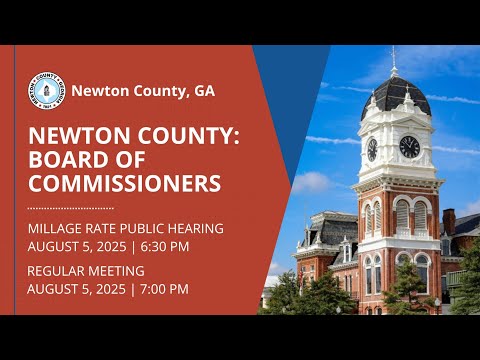
On Aug. 5 the Newton County Board of Commissioners adopted a millage rate of 8.567 mills for county maintenance and operations (a 0.801‑mill increase), a change the county says will raise property taxes by about 10.31% to support the fiscal‑year 2026 budget. Commissioners and residents debated the increase at a required public hearing.
The Newton County Board of Commissioners on Aug. 5 adopted a millage rate that the county finance director said will increase county property tax revenue by about 10.31% to support the fiscal‑year 2026 budget. Finance Director Britney White told the board the adopted county maintenance and operations rate is 8.567 mills (an increase of 0.801 mills) and the county’s fire district rate is 0.892 mills.
White said the millage rate will “support the budget that was adopted on 06/17/2025, which was our FY26 budget,” and listed budget drivers that the county says explain the increase: about $3.7 million for a comp‑and‑class salary increase; $1.5 million tied to a 14% health‑insurance increase; $1.75 million for contingency and new positions to support SPLOST projects and public‑works crews; about $1 million for road repairs; and $750,000 for culvert replacements. White said those needs total about $8.7 million in new revenue for FY26.
The county’s tax‑increase statement read into the record said, “Newton County has tentatively adopted a millage rate, which will require an increase in property taxes by 10.31%. This tentative increase will result in a millage rate of 8.567 mills, an increase of 0.801 mills. Without this tentative tax increase, the millage rate will be no more than 7.766 mills.” The statement estimated the proposed tax increase at roughly $100.93 for a home with a fair market value of $325,000 and about $96.12 for a non‑homestead parcel valued at $300,000.
The board held the third of three required public hearings on the increase. Members of the public spoke for and against the change. Cynthia Van Vinkt, a 76‑year‑old resident, said the increase would be “way too high for seniors” and asked the commissioners, “Please do not make the seniors have to pay that much.” Other speakers voiced similar concerns about affordability and asked the county to identify savings or alternative revenue sources.
Several speakers and commissioners also raised the county’s ongoing payments to the Solid Waste Authority. Resident Dennis Taylor asked why the county continues funding the authority and described perceived double charges for waste service. Commissioner Edwards responded that the county makes an annual payment to the Solid Waste Authority to service debt from a prior settlement and said the county currently pays $750,000 per year to the authority to cover that obligation.
Commissioner Leanne Mason told residents the board is trying to balance service needs with affordability and noted that local growth and higher property values also increased tax bills for many homeowners. Mason said the board has sought rollbacks in past years and that costs – for public safety, roads and facilities – accompany requests for additional services.
At the end of the hearing the board voted to adopt the millage rate. Finance staff had advertised the required hearings; White said the first two hearings were both held on July 29 (11 a.m. and 6 p.m.) and the Aug. 5 session completed the statutorily required process.
The board and staff repeatedly pointed out a jurisdictional limit: a speaker read a statement into the record reminding residents that the Board of Commissioners sets the county millage rate only, and that the Newton County School System is a separate governmental entity whose school board sets school millage (the transcript references that the school portion accounts for roughly 59% of the property‑tax bill in 2025). The county noted that questions about school taxes should be taken to the Board of Education.
Decision and next steps: the board adopted the 2025 millage rate to fund the FY26 budget. No separate direction to staff or follow‑up assignments on tax relief or exemptions were recorded during the hearing; commissioners discussed state‑level options such as House Bill 581 and said they will continue advocacy and budget work at the state level.
What was not decided: the board did not change school taxes (those are set by the Newton County School Board), and no additional voter referendum or new exemptions were adopted during the meeting.