Get Full Government Meeting Transcripts, Videos, & Alerts Forever!
Get email alerts on the School Finance topic
No spam. Unsubscribe anytime.
Alpine board adopts FY25–26 tax rate after hearing; capital levy raised 0.0004, debt service reduced 0.0003
Summary
After a two-hour hearing and more than two dozen public comments, the Alpine School District board set the district’s final tax rate for FY2025–26 at 0.005774 (five of seven trustees in favor). The package raises the capital levy by 0.0004 and reduces the debt service levy by 0.0003.
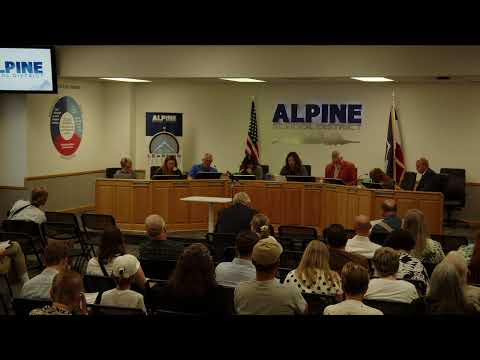
The Alpine School District Board of Education set the district’s final property tax rate for fiscal year 2025–26 at 0.005774 on Wednesday following a truth-in-taxation hearing and discussion. The board approved the rate on a 5–2 roll-call vote.
The adopted total rate includes: the state-set basic school levy at 0.001379 (unchanged); the board local levy at 0.000977 (no change); the voted local levy at 0.001152 (no change); a capital local levy of 0.001729 (an increase of 0.0004 above the certified tax rate); a debt service levy of 0.00444 (a decrease of 0.0003 below the amount needed for FY25 payments); and the charter school levy at 0.000093, for a total rate of 0.005774. The motion to set the rate was moved by Board member Lincoln and seconded by Board member Wilson. Roll-call: Wilson—Aye; Lincoln—Aye; Clement—Aye; King—Aye; Bateman—Aye; Peterson—Nay; Beeson—Nay.
Business Administrator Jason Sundberg explained the technical mechanics of “increments” (the fourth decimal place) and said the specific package before the board would add one net increment compared with the certified rate, a roughly 1.76% net increase compared with the certified-rate scenario. Sundberg and staff described three main goals: (1) provide flexibility for start-up costs associated with the forthcoming district splits, (2) build capital fund balance to reduce reliance on bond financing and thus save interest costs over time, and (3) preserve qualifying tax increments that help districts secure state funding.
Sundberg told the board, “The most that this board tonight can decide is to do the 4 increments in capital,” and he explained that four increments in capital would generate roughly $22–23 million new in the capital fund while the recommended three‑increment reduction in debt service would use fund balance to cover near-term payments. Staff estimated each increment generates approximately $5.7 million in new revenue; a single increment on the median $520,000 home was presented as about $28.60 per year.
Public comment was extensive and sharply divided. Some speakers urged the board to reject any tax increase, citing rising household costs and what they described as repeated annual increases by the district; commenters criticized administrator pay and asked the board to live within current means. Speakers opposing the increase included Brent Gray (virtual), John Barrick, John Gadd, Brandon Wallace, Devin Noyes and several others who said the cumulative tax burden on fixed-income residents is unsustainable. One frequent theme was that voters recently approved splitting the district into three and that the new districts should set their own priorities and taxes.
A smaller group of commenters urged support for additional funding tied to maintaining class sizes, special education services and funds to build or staff new schools created by growth and the district split. Jonathan Bejarano and Guy Fugal were among those who said modest increases could reduce later pressure on new districts and preserve services.
Board discussion noted the district’s growth and deferred maintenance, the legislature’s changing rules for the 20‑increment state guarantee, and the existence of a debt service fund balance that staff proposed partially draw upon to smooth payments. Trustees acknowledged the political sensitivity of tax action and the strain on households; several said they had not made a final decision before the hearing. The board adopted the proposed rate 0.005774 (motion: Board member Lincoln; second: Board member Wilson). The final tax-rate notice and levy schedule will be included in the district’s FY25–26 budget documents and posted per state law.