Get Full Government Meeting Transcripts, Videos, & Alerts Forever!
Get email alerts on the Road And Bridge topic
No spam. Unsubscribe anytime.
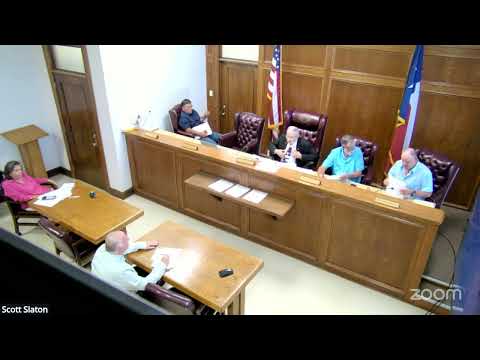
Commissioners debate Road & Bridge budget, equipment purchases and contingency allocations
Summary
County commissioners spent the bulk of the workshop reviewing Road & Bridge budgets for each precinct, debating whether to buy heavy equipment (blades, rollers, haul trucks) versus continuing expensive leases, and agreeing to shift portions of fund balances into contingency to preserve options.
County commissioners spent more than two hours on details of Road & Bridge budgets, focusing on whether to continue renting heavy equipment or buy it outright, and how much of each precinct’s fund balance to place into contingency.
The discussion centered on four practical choices: keep leasing specialized equipment (rollers, blades, mixers), purchase used or new equipment (commissioners discussed a used blade under $100,000 and new equipment costing substantially more), reduce crew positions to lower salaries, or cut materials and operating lines. Commissioner Mitch opened the Road & Bridge portion and led much of the equipment and materials discussion; other speakers who participated included Bobby, Brandon and the judge.
Why it matters: road maintenance is the largest recurring expense in the precinct budgets and often drives year‑to‑year funding decisions. Commissioners said buying equipment would reduce monthly rental costs that can reach roughly $5,000 per month for some machines, and would convert recurring rental expense into an asset that can be sold or used for trade‑in value.
Most important facts and directions - Equipment vs. lease: Commissioners discussed the cost tradeoff of buying a roller and a blade (estimated in the discussion at roughly $98,000 for a roller and “over $300,000” for a high‑end blade in the transcript) versus continuing lease payments (examples cited: $5,000 per month rental, and a $12,000/month lease for a mixer). Commissioners and staff noted some leases include rent credit toward purchase. - Capital outlay and equipment purchase lines: Several commissioners proposed keeping $100,000 in equipment purchase and $200,000 for capital lease equipment in the budget; Mitch said he did not want to remove the $100,000 equipment purchase allocation. - Contingency and fund balance: Commissioners agreed to move portions of precinct fund balances into contingency lines so funds remain available for equipment buy‑outs or emergency needs. For example, Mitch stated a fund‑balance figure of $379,000 and said he wanted that available in contingency while keeping most funds “touchable.” - Staffing and material tradeoffs: Commissioners weighed cutting one full‑time road hand (salary cited in discussion at about $68,000 net benefits) against reductions in materials lines and uniforms, shop supplies and building maintenance. Several precincts proposed lowering miscellaneous and shop supply lines to free funds for capital purchases.
Context and details Commissioners repeatedly returned to the operational tradeoffs: one speaker noted that doing more base and subgrade work requires more time and materials but results in a longer‑lasting road, while another emphasized overlay/sealcoat approaches as a way to cover more miles quickly. A participant said a 4‑inch cap could cost about $27,000 in material and roughly $45,000 per mile to place, while an overlay-only approach was presented as roughly $65,000 per mile but not addressing base issues; those figures were presented during discussion as estimates and should be treated as such.
Equipment logistics also were discussed in detail: roller ownership would reduce repeated rental expense but requires storage, maintenance and trained operators; leased machines sometimes include credits toward purchase through vendors such as Ramco (identified during the conversation). Commissioners said lease buyouts were approaching for several units and they must decide whether to buy out or replace equipment on lease terms.
Process and next steps Commissioners directed staff to: 1) maintain a $100,000 capital equipment purchase line and a $200,000 capital lease line in the Road & Bridge budget; 2) move clarified portions of precinct fund balances into contingency lines (exact amounts recorded in each precinct’s proposed budget); 3) circulate the updated road‑and‑bridge worksheets to commissioners for review ahead of the next meeting; and 4) return with more precise lease buyout figures and a clearer list of critical equipment priorities (blade, roller, haul truck, trailer, mulcher attachment).
Attributions and speakers Speakers identified in the record who participated in the Road & Bridge discussion include Mitch (speaker identified in transcript), Bobby, Brandon, Judge, Ben (staff member), Virgil (former staff/consultant referenced), Susan (staff member). Direct quotes used in the meeting were taken from those speakers’ remarks in the transcript; the article does not attribute paraphrased budget numbers to any person unless the transcript linked them to a speaker.
Ending note Commissioners agreed to continue refining precinct budgets and equipment priorities, circulate updated worksheets, and plan a follow‑up review before posting a public draft of the budget. No formal motions or votes were recorded in the transcript for purchasing equipment; the discussion produced direction to staff rather than an approval to spend.