Get Full Government Meeting Transcripts, Videos, & Alerts Forever!
Get email alerts on the Land Use Restoration topic
No spam. Unsubscribe anytime.
Weaver’s Cove owner proposes 150 plantings, monitoring after unauthorized clearing; commission orders third-party review
Summary
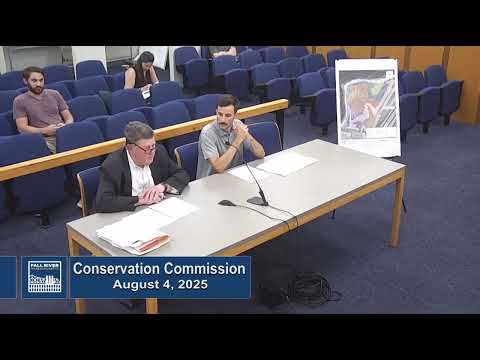
Weaver Cove Industrial Park LLC presented a phased ecological restoration plan on Aug. 4 to the Fall River Conservation Commission to address vegetation clearing on a portion of the Weaver’s Cove parcel and adjacent National Grid land, and the commission voted to refer the full restoration plan to a third‑party consultant for review.
Weaver Cove Industrial Park LLC presented a phased ecological restoration plan on Aug. 4 to the Fall River Conservation Commission to address vegetation clearing on a portion of the Weaver’s Cove parcel and adjacent National Grid land, and the commission voted to refer the full restoration plan to a third‑party consultant for review.
The plan, presented by attorney Chip Nylund on behalf of the applicant, describes revegetation measures for coastal bank and salt‑marsh resource areas and proposes 52 trees and 105 shrubs plus seed mixes and monitoring. Nylund told the commission, “We know that what we did was wrong, and that’s why we’re looking to restore that.”
The restoration matter matters because the clearing overlaps coastal bank and salt‑marsh resource areas regulated under the state’s wetlands framework and because portions of the work shown on plans lie on land National Grid says it did not sign over. The commission directed staff to obtain independent technical review so the city can condition any order of conditions precisely for the land under its jurisdiction.
Goddard Consulting wetland scientist Chris Frattaroli said the altered area has “revegetated remarkably well on its own” in places and that much of the open ground is covered by herbaceous species; he recommended targeted seeding for small bare spots and plantings concentrated on the coastal bank to increase root mass and stability. Frattaroli described the resource mapping presented to the commission as coastal bank, salt marsh and a riverfront buffer and said the team proposed differing responses by zone, limiting plantings in areas likely to be affected by future National Grid work.
Olympia Bowker, an attorney with Anderson & Krieger representing National Grid, told the commission National Grid had not signed a notice of intent and therefore “the board could not condition the work that fell on your property,” and warned the commission it could not require restoration on land where the owner had not acknowledged the alteration.
The conservation agent recommended the commission follow its usual practice and retain an independent third‑party consultant to review delineation, alteration and the proposed restoration and then serve as the restoration monitor. Commissioners discussed the desirability of a single, consolidated restoration approach covering both parcels if National Grid files its own notice, but the panel also asked for a fallback plan that would allow the commission to require restoration on the applicant’s parcel if National Grid does not cooperate.
Commissioners voted to refer the full restoration plan to a third‑party consultant for review; the motion passed unanimously. The vote does not by itself create an order of conditions and any future conditions will be limited to the parcel(s) actually before the commission at the time an order is issued.
The commission recorded several technical clarifications on the record: the enforcement action dates to 2024; the applicant reports ownership of roughly 50 acres of the Weaver’s Cove parcel since 2016; Frattaroli’s site assessment noted abundant volunteer resprouts of oak and birch and extensive herbaceous cover (switchgrass, bluestem, goldenrod); Frattaroli estimated about 90% of the mapped salt marsh is currently vegetated with marsh species but noted some thinner areas and invasive phragmites cover in roughly 40% of the salt‑marsh polygon.
Next steps: staff will solicit quotes for a mobile third‑party consultant, provide commissioners with the list of candidates and return at a subsequent meeting with a consultant selection. The commission said any approval of conditions later will be scoped to the parcel(s) for which a notice of intent and associated property‑owner signatures have been filed.