Get Full Government Meeting Transcripts, Videos, & Alerts Forever!
Get email alerts on the Council Rules topic
No spam. Unsubscribe anytime.
Wausau committee backs package of council rule changes on public comment, civility and packet deadlines
Summary
The Committee of the Whole recommended a set of council rule changes — including requiring public comment on standing committee agendas, a civility statement, clearer mayor communications and a firm packet-materials deadline — and forwarded the package to the full council for September review.
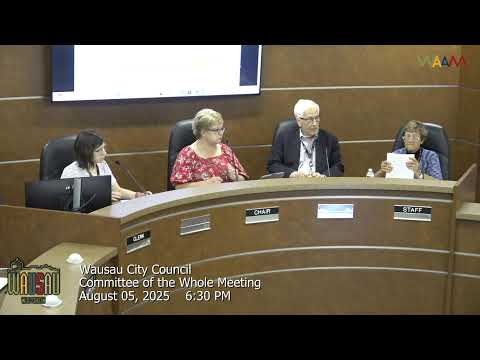
The City of Wausau Committee of the Whole on Aug. 25 recommended that the City Council consider a package of rule changes aimed at standardizing public-comment procedures, clarifying a civility statement read at meetings, tightening agenda-notice requirements and setting a firm deadline for packet materials.
The rules review committee presented several linked changes and the committee voted to forward them to the full council in September. Motions to adopt individual items or the package were approved during the meeting; one motion that moved the mayor’s communications item later in the agenda passed with “one opposed,” according to the record.
Committee discussion focused on four topics: (1) making “public comment regarding agenda items” a standing agenda item for every standing committee; (2) adding a civility/public-comment statement read at council meetings and clarifying whether the presiding officer “may” or “shall” interrupt disruptive speech; (3) reorganizing the “order of business,” including where mayoral communications appear on the agenda; and (4) a clarified “introduction of business” (packet-materials) rule that sets a deadline for submission and allows a waiver “for good cause.”
Alder Gisselman, chair of the rules review committee, told the committee that the change to require public comment on standing-committee agendas was intended to reduce inconsistency: “public comment is most impactful when you take it with the relevant agenda item that people want to talk about,” he said, while supporting an approach that would make the practice consistent across committees. The committee voted to recommend adding that item to standing-committee agendas and to ask the clerk to implement the same pattern for boards and commissions when the city’s CivicPlus agenda software is deployed.
Anne, the city attorney who drafted the language, and Caitlin (clerk/staff) described a late revision that added a cross-reference under Rule 16 clarifying a citizen’s right to address a standing committee under Rule 13.F.4. Anne apologized for the late change, saying, “these were made in the last hour and a half because I was out for 2 weeks on vacation,” and explained staff had adjusted wording the afternoon of the meeting.
Committee members debated whether the civility statement should use “may” or a stronger verb such as “shall” or “will” to describe the chair’s ability to interrupt or terminate disruptive remarks. Some alderpersons argued for preserving chair discretion; others said stronger language would make enforcement clearer to the public. The committee approved the civility statement language as presented by motion.
The committee also discussed where to place a mayoral “communications and recommendations” item. Members cited Robert’s Rules of Order and a state statute excerpt shown during the meeting that permits the mayor to “give all council such information, recommend such measures as the mayor may deem advantageous to the city,” but participants disagreed on whether such communications should lead off meetings. Several alderpersons said they preferred moving mayor comments to the end of the agenda so the council can first complete scheduled business. A motion to move the mayor-communications item later in the agenda passed with one recorded opposed.
On packet materials, the committee agreed on a clearer filing expectation: written communications, proclamations and similar materials should be filed in the clerk’s office no less than seven days before the meeting. The proposed rule also states, “in no case will packet materials be accepted after the close of business on the preceding week,” while still allowing the council or a committee chair to waive that requirement if “for good cause this prefiling is impossible or impractical.” Caitlin described that waiver language as intended to preserve narrow flexibility for urgent, time‑sensitive matters.
Committee members discussed practical consequences: the rule would give the clerk staff a clear cutoff and prompt staff to seek special meetings when an item cannot meet the deadline, while alderpersons said staff and council should use waivers sparingly and reserve them for time‑critical, unavoidable circumstances. Several alderpersons noted past meetings where late materials constrained review time and urged staff to set internal deadlines so elected members have adequate time to review contracts or high‑dollar items.
Several procedural points were clarified during discussion: chairs retain discretion to accept comments during the course of an item, public hearings remain subject to separate statutory rules and time limits set for ordinary public comment do not apply to formal public hearings.
All of the proposed rule changes discussed were forwarded to the full City Council for its first September meeting, where the council will decide whether to adopt them.
“That motion carries,” the chair declared after a vote forwarding items to council.
The Committee of the Whole adjourned after completing its review of the rules package.