Get Full Government Meeting Transcripts, Videos, & Alerts Forever!
Get email alerts on the Brownfields Cleanup topic
No spam. Unsubscribe anytime.
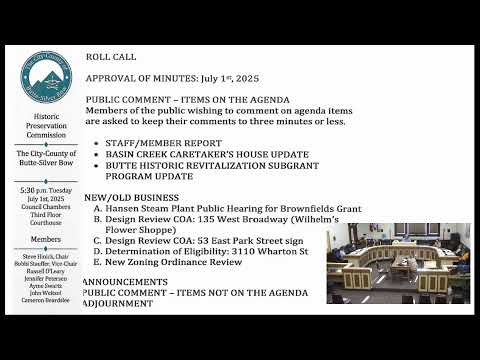
Owners outline targeted cleanup plan, timeline for Hansen Steam Plant brownfields project
Summary
Owners and consultants presented a plan to remove contaminated soils from the Hansen Steam Plant site to enable commercial reuse as an event venue; the project is in a 30-day public comment period and aims to start excavation this October using targeted remediation and revolving loan funding.
Butte — Owners of the Hansen Steam Plant and their consultants told the Historic Preservation Commission they plan a targeted cleanup of contaminated soils and limited building abatement so the property can be reused commercially as an event venue. The project is now in a 30-day community comment period that ends Aug. 13, with the project team committing to publish a community outreach report by Aug. 18.
The project matters because it combines hazardous‑materials cleanup, historic‑building preservation and public funding. Melissa Wanamaker, a project lead, said the Christiansens have “been through a phase 2 ESA and and a supplemental phase 2 ESA” and are preapproved for low‑interest financing. Wanamaker said the project “saves a historic structure,” “adds to the needed inventory of wedding venue and event space,” “creates jobs,” and leverages funding including “200,000 from Montana State Historic Preservation that will be able to complete the roof.”
Marcus, the technical consultant who led the sampling and the Analysis of Brownfields Cleanup Alternatives (ABCA), summarized the contamination and the cleanup options. He listed the site’s contaminants of concern as “arsenic, lead, and barium, and then some, sort of exotic hydrocarbons in the soil,” and he noted the building also contains nonfriable asbestos and lead‑based paint. After evaluating three alternatives — no action, full remediation, and targeted cleanup for commercial reuse — the team recommended targeted remediation as the most feasible route.
Marcus explained the chosen approach: “targeted cleanup at the site… removing soil from the interior of the building and the perimeter of the building down to about 3 feet, and then replacing that with backfill clean backfill,” and removing soil down to 12 inches in high‑use exterior areas. He said abatement of asbestos‑containing materials and lead‑based paint would be handled by the owner following appropriate disposal rules and that some terraces would remain cordoned off for later remediation. Marcus said this limited cleanup “does allow the site to be used as the event center” while keeping costs to roughly a tenth of a full site cleanup.
On disposal, Marcus said, “the soil actually would be able to go to the View landfill. It's not at levels that we see, like, in mine tailings.” Wanamaker said the Christiansens have been working with DEQ (Department of Environmental Quality) and the EPA and that they have approval processes in progress with Brownfields and Headwaters loan committees; she also said Headwaters has a revolving‑loan program funded in part by an EPA brownfields grant. Wanamaker said the project team intends to put a bid package to contractors in the coming six weeks and hopes excavation work will start in October, after which vertical construction could follow.
The project team emphasized community outreach and documentation. Wanamaker said the planning team posted project documents widely, sent them to planning, zoning, historic‑preservation and community development partners, and placed a public on‑site sign with a QR code linking to project documents. She told the commission: “We are in the 30 day community comment period. We did post it on social media newsletters. We, Put it out by email… We sent it out to media partners.” The team said they will incorporate community comments into the bid documents.
No formal vote or land‑use approval was sought from the Historic Preservation Commission at the meeting; the presentation was informational and to solicit public input. Commissioners asked technical and logistical questions about the scope of removal, the disposition of the removed soils, and whether concrete or interior finishes would be removed; Marcus and Jason Christiansen answered that concrete would be left in place and excavated soils would be replaced with clean fill, with additional topsoil for landscaping if owners choose.
The public comment period runs through Aug. 13, and the project team will publish a closing community outreach report by Aug. 18. The team said next steps include finalizing a sampling plan, issuing bid documents for excavation, and beginning excavation work in October if bids and approvals are finalized.