Get Full Government Meeting Transcripts, Videos, & Alerts Forever!
Get email alerts on the Judiciary Rule Vs Statute Alignment topic
No spam. Unsubscribe anytime.
Sponsors say bill will align Ohio law with Supreme Court rules to reduce conflicts
Summary
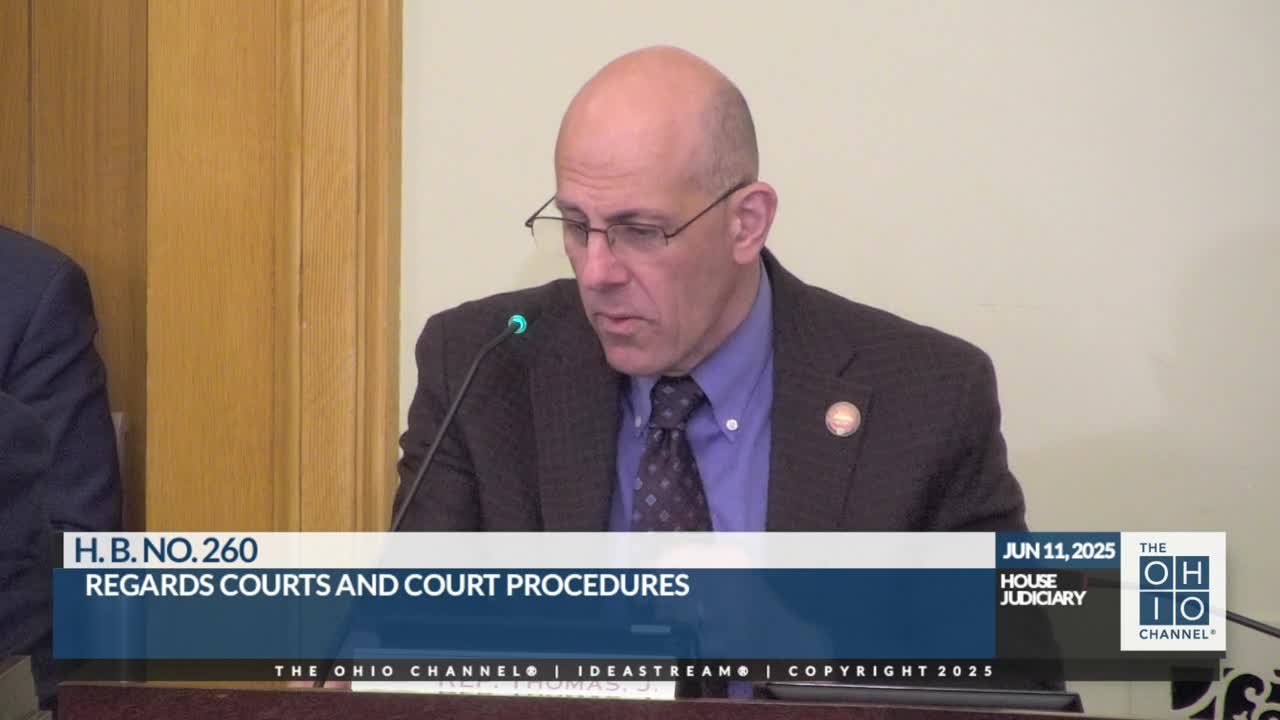
Columbus — Sponsors of House Bill 260 told the Ohio House Judiciary Committee the bill is intended to resolve conflicts between the Ohio Revised Code and rules of practice and procedure promulgated by the Ohio Supreme Court.
Columbus — Sponsors of House Bill 260 told the Ohio House Judiciary Committee the bill is intended to resolve conflicts between the Ohio Revised Code and rules of practice and procedure promulgated by the Ohio Supreme Court.
"This legislation would modify and repeal sections of the revised code that overlap or conflict with the rules of practice and procedure and the rules of superintendents that have been adopted by the Supreme Court pursuant to its constitutional authority," Representative Odioso said in sponsor testimony, citing the "modern courts" amendment to the Ohio Constitution.
Witnesses said the 1968 amendment granted the Supreme Court authority to adopt rules governing practice and procedure and local-court superintendence; those rules now include the Ohio Rules of Evidence, Civil Procedure, Criminal Procedure, Juvenile Procedure and Appellate Procedure. Sponsors argued statutes that predate the modern-court amendment can overlap with current court rules and that House Bill 260 (a companion to Senate Bill 61) would streamline the Revised Code by repealing or modifying statutes that conflict with court rules.
Representative Isaacson asked for clarification on a provision in the bill summary that would allow a defendant in a tort action to raise an affirmative defense attributing a percentage of conduct to persons for whom recovery is not sought. Sponsors said they would defer detailed drafting questions to court practitioners and that interested parties would be able to weigh in.
Representative Williams asked for an interested-party meeting to parse sections of the bill that address grand-jury procedure, specifically a provision that he said appeared to remove a four-person review requirement for grand-jury oversight. The sponsors responded that the bill is intended as a cleanup to align statute with current practice and that the committee could identify sections it wished to assert or disapprove as the rules process proceeds.
Sponsors urged the committee to consider the bill favorably; the hearing concluded with committee questions and no formal vote recorded.