Get Full Government Meeting Transcripts, Videos, & Alerts Forever!
Get email alerts on the Public Safety Move Over Law topic
No spam. Unsubscribe anytime.
Ohio panel hears emotional appeals to strengthen "move over" law after roadside deaths
Summary
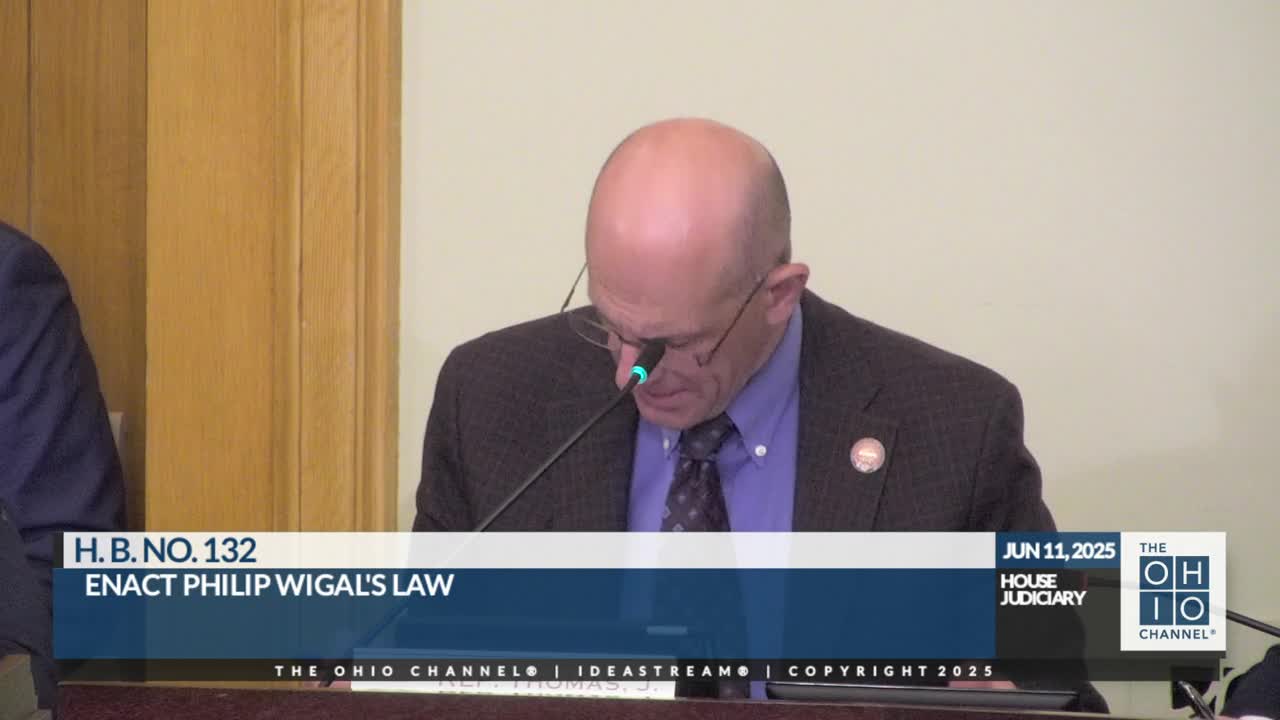
Columbus — The Ohio House Judiciary Committee heard proponent testimony on House Bill 132, commonly referred to by supporters as the "Philip Waggle" law, aimed at increasing criminal penalties and public education tied to Ohio's move-over law to protect firefighters, police and roadside workers.
Columbus — The Ohio House Judiciary Committee heard proponent testimony on House Bill 132, commonly referred to by supporters as the "Philip Waggle" law, aimed at increasing criminal penalties and public education tied to Ohio's move-over law to protect firefighters, police and roadside workers.
Supporters told the committee the bill would create a new vehicular-assault offense for serious injuries caused by move-over violations, raise fines and mandate license suspensions in the most serious cases, require driver's-education instruction on the law, and direct the Ohio Department of Transportation to add warning signage about criminal penalties. "House Bill 132 delivers exactly that. It creates a new vehicular assault offense when serious harm is caused due to violations of the Move Over Law," said Michael Evans, speaking for the Ohio Association of Professional Firefighters.
The bill's proponents framed the measure as a public-safety response to several roadside fatalities. "He was killed in the line of duty on 04/11/2022 ... He was only 35 years old," testified Mike Waggle, who identified himself as the father of Lieutenant Philip Michael Waggle of the Town and Country Fire Department. "For the legacy of my son, but to save other families from getting that same phone call." Chief Adam Horry of the Town and Country Fire District described the frequent hazard his crews face on Interstate 71 and said, "fire is way more predictable than the drivers we face."
Witnesses cited state enforcement and crash data during testimony. Chief Horry said multi-state enforcement in July 2024 issued 1,134 citations during a weeklong blitz, with Ohio issuing about 511 of those stops. Committee members also heard a recounting of other recent roadway deaths involving a county road crew member in Richland County.
Some lawmakers raised drafting concerns about the bill's language and penalties. Representative Rob McColley-Williams (Representative Williams in the transcript record) asked about broad statutory phrases such as "proceed with due caution" and whether that standard would be sufficiently precise for criminal enforcement; several witnesses indicated they were open to working with the committee on mens rea and sentencing language. Representative Williams also questioned the size of proposed fines; Michael Evans said proponents viewed the proposed increase as a meaningful deterrent while signaling willingness to refine statutory language.
The committee did not take a final vote on the measure during this hearing. Sponsors and supporters said they will work with legislators on specific statutory language before the bill advances.
The measure drew endorsements from career and volunteer firefighter groups and the County Engineers Association, which emphasized the everyday exposure of road crews to traffic risk and supported stronger enforcement and education.
If advanced, the bill would return to committee for further drafting, possible amendment and a future vote, where sponsors and interested parties plan to negotiate language about penalties, the legal standard for "due caution," and the mechanics of license-suspension and education provisions.