Get Full Government Meeting Transcripts, Videos, & Alerts Forever!
Get email alerts on the Child Enticement Reform topic
No spam. Unsubscribe anytime.
Sponsors seek to rewrite Ohio child‑enticement statute to meet Ohio Supreme Court standards
Summary
Representatives Williams and Brennan presented House Bill 168 to redefine child enticement under ORC 2905.05, requiring unlawful purpose or illicit motivation to restore an enforceable enticement offense after the Ohio Supreme Court found the prior statute overbroad.
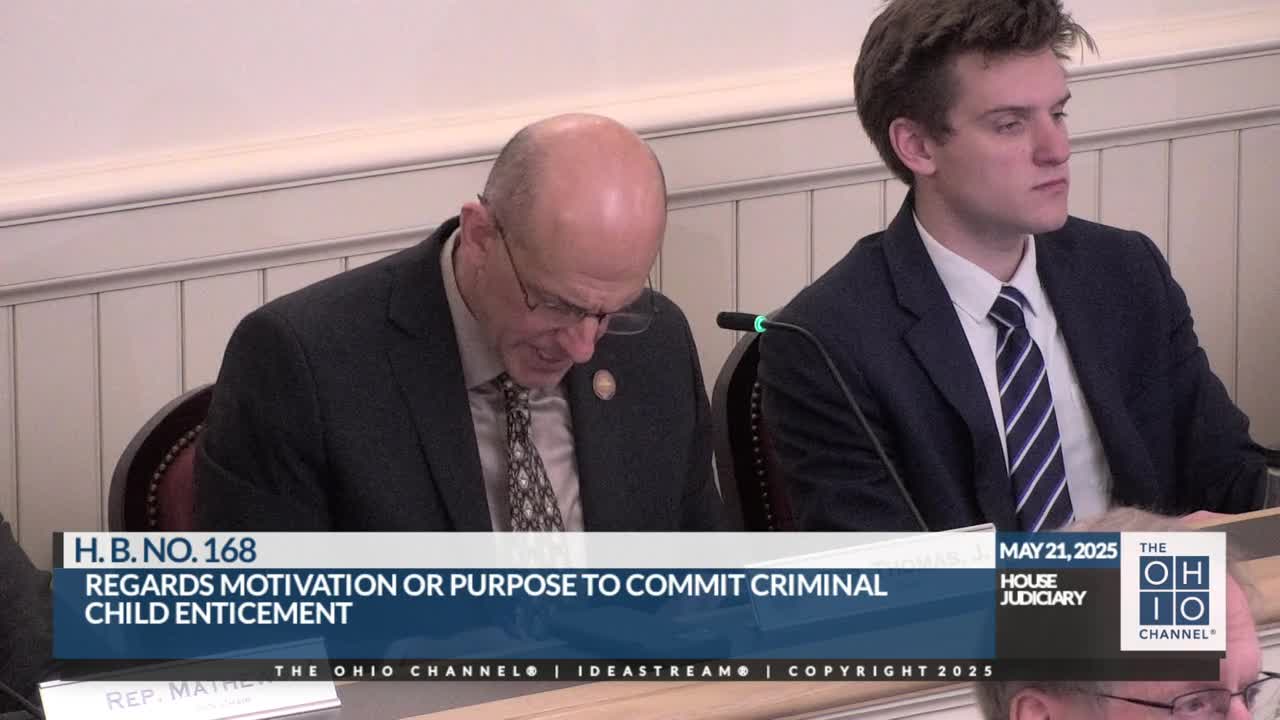
Representatives Williams and Brennan told the House Judiciary Committee that House Bill 168 would revise Ohio's child enticement law, ORC 2905.05, to address a 2014 Ohio Supreme Court ruling that found the prior statute overbroad.
"In 02/2014, the Ohio Supreme Court ruled that our state's child enticement laws were overly broad unconstitutional," Representative Williams said, describing the court's concern that the statute could criminalize constitutionally protected activity. The sponsors said the bill would reestablish an enforceable child‑enticement offense by clarifying that the offender must act with an unlawful purpose or illicit (as described in testimony) motivation and must knowingly solicit, coax, entice or lure a child under age 14 without the parent's permission.
Brennan told the committee the Ramage decision was a key precedent: the Supreme Court found that the statute, as written, could criminalize innocent acts such as asking a neighbor child to carry boxes. The sponsors said HB 168 keeps the deterrent against predatory behavior while narrowing the statute to avoid criminalizing benign conduct. The bill would permit prosecution under the child‑enticement section or other applicable criminal sections but would prohibit stacking sentences for the same conduct, per advice received during prior sessions.
Committee members raised concerns about removing an affirmative defense for acting under a bona fide emergency or reasonable belief that the act preserved the child's health and safety. Williams said the sponsors removed the broad affirmative defense to avoid allowing offenders to claim they believed they were acting for the child's safety in many cases and that they are open to redrafting limited emergency language. Members also discussed Good Samaritan concerns; sponsors said the bill clarifies that lawful purpose is not criminal and that a legal privilege (for police, teachers, etc.) remains distinct.
No committee vote was taken; the bill received sponsor testimony and committee questioning.