Get Full Government Meeting Transcripts, Videos, & Alerts Forever!
Get email alerts on the Farm Bureau Health Plans topic
No spam. Unsubscribe anytime.
Lawmakers hear competing views on Farm Bureau health plans that would be exempt from state insurance oversight
Summary
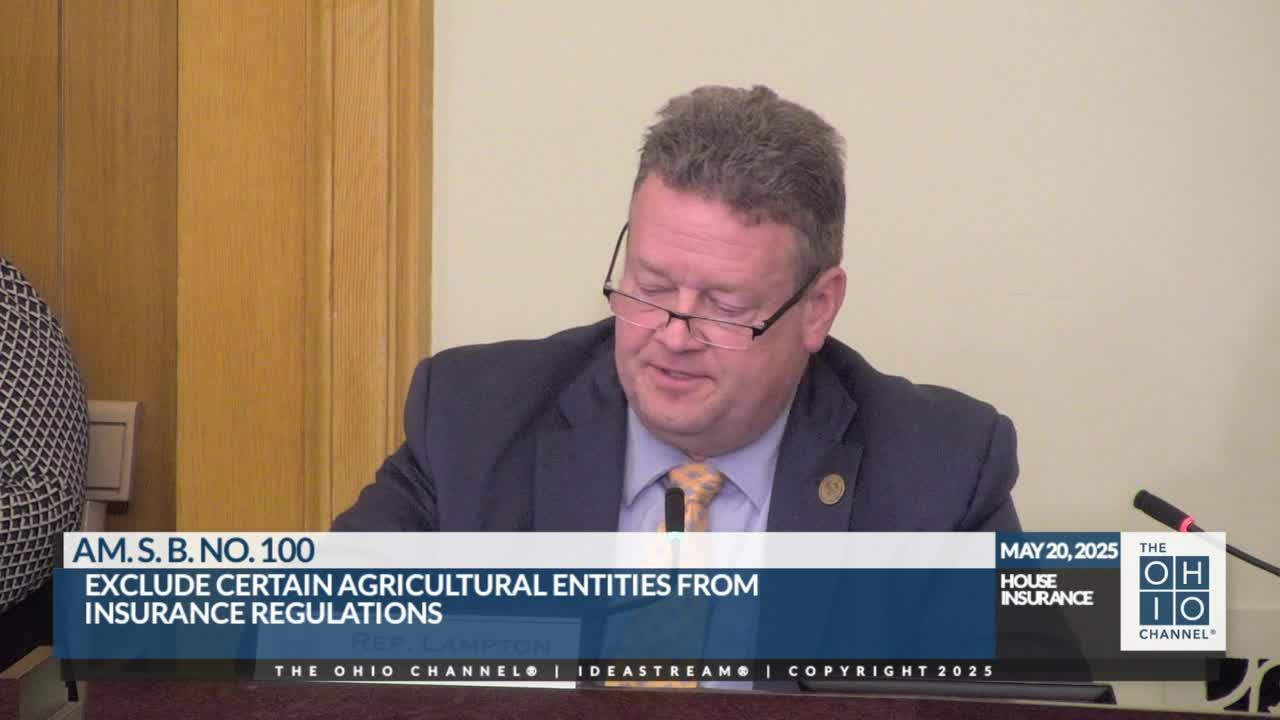
The House Insurance Committee held a second hearing on Senate Bill 100, which would allow the Ohio Farm Bureau to offer member health plans that the bill treats as not subject to state insurance regulation. Bill Patterson of the Ohio Farm Bureau described the plans as a means to expand affordable coverage for farmers. The American Cancer Society
The House Insurance Committee heard proponent testimony and opponent testimony on Senate Bill 100, which would authorize Ohio Farm Bureau to offer member health plans that would not be regulated as traditional insurance under state law.
Bill Patterson, president of the Ohio Farm Bureau Federation Board of Trustees, said the plans would meet a gap in coverage options for farmers who do not have employer-sponsored insurance or stable, predictable income. "These plans have a tenured track record of providing results to a niche group of consumers," Patterson said, arguing Farm Bureau plans can offer stability for agricultural families.
Patterson stated the plans would be contractual, supported by Ohio Farm Bureau resources and reinsurance, and could include access to existing provider networks. He said the proposed legislation would allow Farm Bureau to design coverage outside the traditional insurance classification; on that point he told the committee, "Because these plans would not be classified as insurance, Ohio Farm Bureau would have the flexibility to consider individual health circumstances and design coverage options that better meet the needs of its members."
Opponents raised consumer-protection concerns. Leo Almeida, Ohio government relations director for the American Cancer Society Cancer Action Network, said Senate Bill 100 "creates health plans that look like health insurance, but offer none of the state law safeguards important to diagnosing and treating cancer." Almeida warned the bills could allow plans to discriminate against people with preexisting conditions, deny coverage for cancer-related care, limit appeals and leave consumers without state regulatory recourse.
Almeida and other opponents cited examples from other states operating Farm Bureau plans. He said regulators do not collect comprehensive data on these unregulated plans and recounted individual cases gathered from prior legal proceedings and consumer contacts, including a Tennessee patient left with a more than $40,000 life-flight bill after a Farm Bureau plan denied coverage for recommended treatment-related care, and a woman told her breast-related care would be excluded for seven years despite prior benign biopsies.
Committee members pressed for clarity about the legal classification and consumer protections. Vice Chair Craig said the amendment in the bill declares the product "is not insurance" and asked why that phrase was necessary when the plans contain copays, deductibles and network arrangements. Patterson responded that the product is not insurance under statutory definitions because it would be structured as a non‑insured, membership-based coverage model with contractual obligations and reinsurance, similar to other self-funded group arrangements.
Ranking member Tims expressed concern that the products are not required to cover essential health benefits under the Affordable Care Act and that members could receive surprise medical bills; he asked whether Farm Bureau would clearly disclose such limits to members. Patterson and Farm Bureau witnesses said the organization intends to make disclosures to members and pointed to long-running Farm Bureau member plans in other states (including Tennessee) as operational models.
The American Cancer Society Cancer Action Network and other medical and patient-advocacy groups submitted written opponent testimony (American Heart Association, Association of Clinical Oncology, Ohio Hematology Oncology Society). Proponents included the Ohio Dairy Producers Association. No vote was taken; the hearing concluded with committee members noting outstanding consumer-protection questions and the need for additional detail about member disclosures and coverage limits.
Context: testimony reflected a recurring policy debate—whether membership-based or association plans can expand affordable coverage for niche groups without exposing participants to gaps in coverage or consumer harms. Committee members asked Farm Bureau witnesses for clearer consumer disclosures and for actuarial/claims information from states where similar plans operate.