Get Full Government Meeting Transcripts, Videos, & Alerts Forever!
Get email alerts on the App Store Accountability Act topic
No spam. Unsubscribe anytime.
Sponsor says App Store Accountability Act would centralize parental approval for child app downloads; tech, enforcement questions remain
Summary
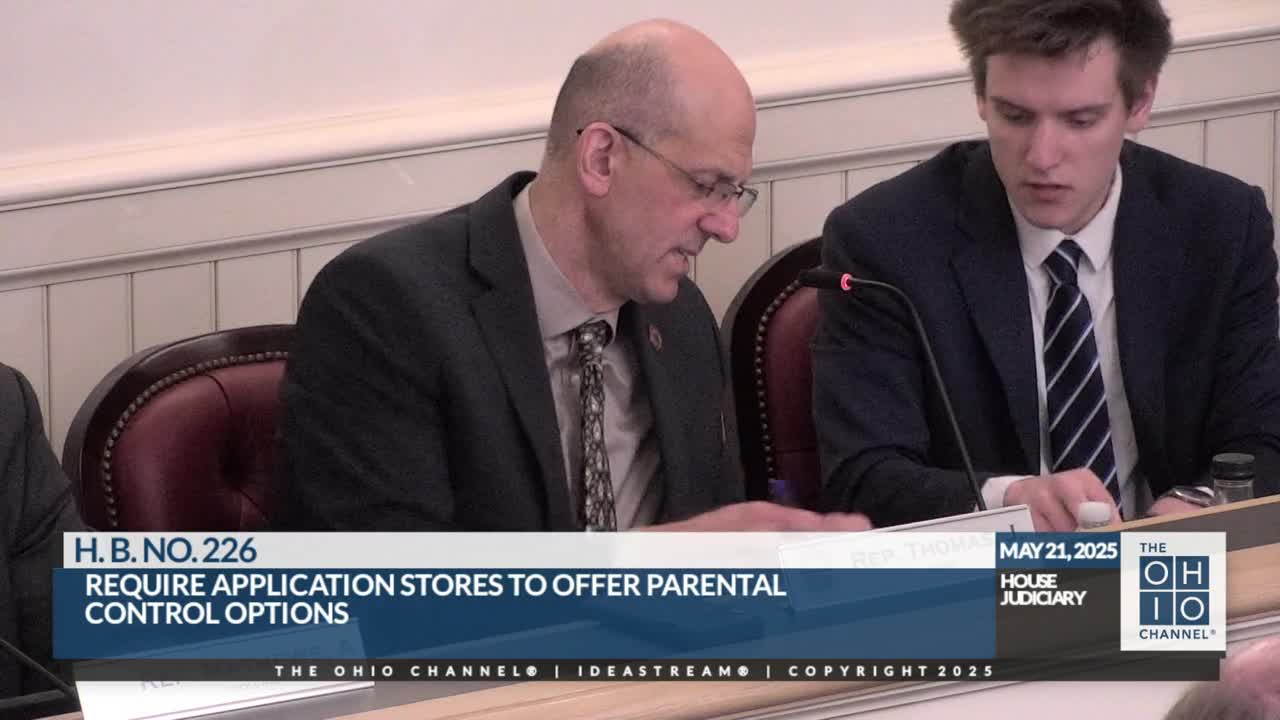
Representative Melanie Miller presented sponsor testimony for House Bill 226, the App Store Accountability Act, which would require parental age verification and app‑store‑level parental approval for minors’ downloads. Lawmakers asked about constitutional risk, interstate and business impacts, enforcement fines and technical feasibility.
Representative Melanie Miller told the House Judiciary Committee that House Bill 226, the "App Store Accountability Act," would require age verification at the app‑store level and centralize parental approval for minors’ app downloads. "When a parent gets their child a smartphone, the parent can easily go into the App store account and confirm number 1, that they are the parent or guardian, and number 2, the child's age," Miller said, describing a one‑time verification at the app store rather than separate approvals per app.
Miller said the bill aims to protect minors from harmful content, enhance data privacy and empower parents to approve or deny downloads via a notification to the parent's phone. She cited polling she said showed broad support among Ohio parents and said the substitute borrows language from Utah’s recent law enacted May 7 and similar laws in other states.
Committee members asked procedural and constitutional questions. Ranking Member Isaacson asked why the bill would survive legal challenges that felled prior app‑by‑app provisions; Miller argued the store‑level approach is about parental authority and contract enforcement rather than direct content regulation and that the state is pursuing a different legal theory. Several members raised commerce and cross‑border concerns: Representative Timbs asked how parental controls would operate if a child crosses state lines and downloads an app outside Ohio, and Representative Plummer raised possible burdens on businesses and retailers with apps.
Representative Mohammed asked about enforcement and the civil penalty level; Miller said the proposed $2,500 figure was modeled on other states’ proposals. Representative Williams and others noted existing parental‑control tools and asked why statutory mandates are necessary; Miller said the bill is intended to close loopholes in current systems and that technical experts would address details in later testimony.
Committee members signaled that they expect technical and legal experts to testify in future hearings; the subbill previously was accepted by the committee at the start of the hearing. No committee vote on final passage occurred at this session.