Get Full Government Meeting Transcripts, Videos, & Alerts Forever!
Get email alerts on the Breast Screening topic
No spam. Unsubscribe anytime.
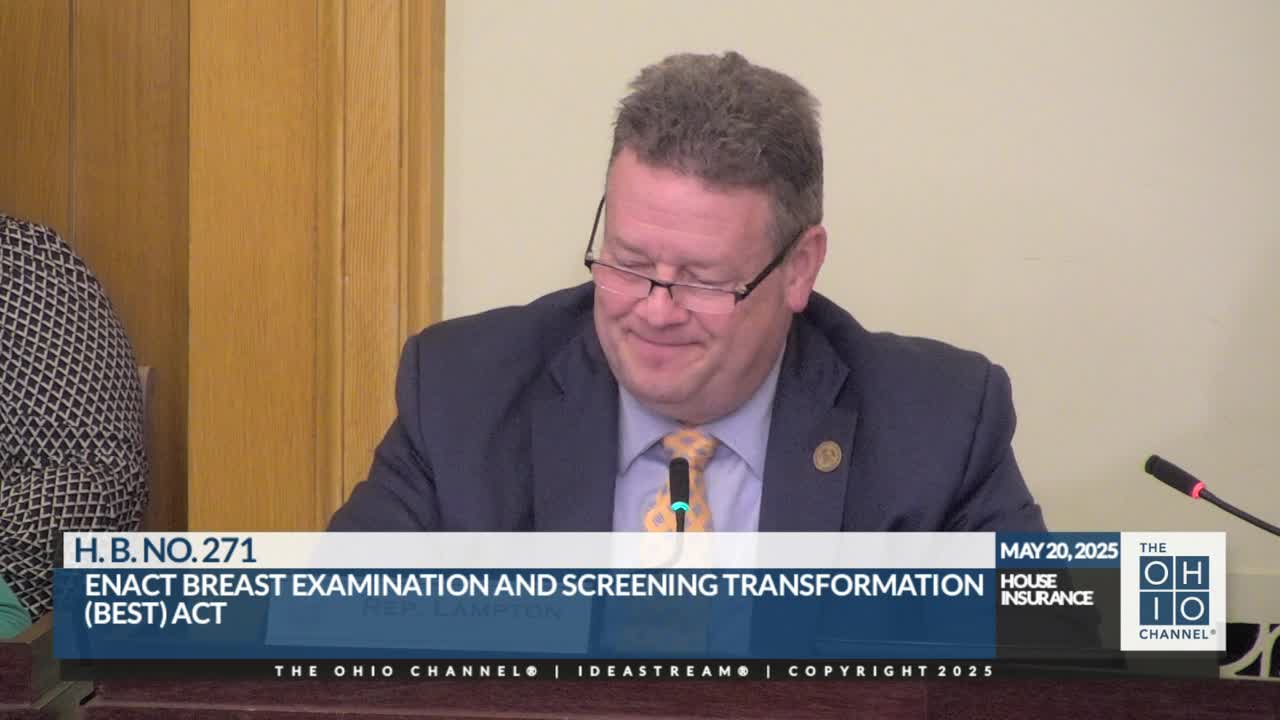
Committee hears BEST Act to clarify and expand coverage for supplemental breast screenings
Summary
Representatives Jean Schmidt and Josh Williams presented House Bill 271, the BEST (Breast Examination and Screening Transformation) Act, in the House Insurance Committee. The bill would clarify definitions between supplemental and diagnostic breast screenings, expand coverage to include diagnostic screenings and eliminate out-of-pocket costs for
Representative Jean Schmidt and Representative Josh Williams testified in favor of House Bill 271, the BEST Act, telling the House Insurance Committee the bill would clarify and expand insurance coverage for supplemental breast screenings and remove out-of-pocket costs for patients.
"The BEST Act will alleviate these problems," Schmidt said, explaining the bill "clarifies the definitions of supplemental screenings and diagnostic screenings to prevent miscoding or misidentifying the type of screening and coverage of supplemental screenings intended in House Bill 3 71." She described barriers that remain even after earlier legislation that expanded mammogram coverage and said the bill ensures no out-of-pocket costs for supplemental or diagnostic screenings.
Representative Josh Williams said screening and early detection save lives and stressed that the bill would make additional screenings more accessible and affordable. He cited state-level diagnosis numbers from 2017–2021: "Between 2017 and 2021, around 10,000 Ohio women were diagnosed with breast cancer," and noted that about 72% were diagnosed at early stages, which has a much higher five-year survival rate.
Committee members asked about the bill’s age coverage, medical catalysts for the bill and federal guidance related to breast density. Schmidt said the bill maintains an adult coverage threshold of 18 and over, noting the previous statute (House Bill 371 enacted in 2022) expanded coverage and that the sponsor wants to remove financial barriers to supplemental imaging for people with dense breasts. Representative Barhorst asked whether new causes of breast cancer had emerged; committee members also referenced recent federal notifications on breast-density reporting and urged discussion about premium impacts.
Williams pointed to actuarial estimates cited by advocacy groups (Susan G. Komen) and told the committee that the estimated premium increase in the highest-cost state (Massachusetts) was between $0.19 and $0.33 per member per month; he said most states report a smaller impact.
The hearing was a first hearing and informational: no committee vote occurred. Sponsors said they would provide additional data and welcomed questions from the committee.
Context and next steps: supporters framed the bill as a targeted clarification to ensure that supplemental imaging (ultrasound, MRI, tomosynthesis and future technologies) is correctly coded and covered when clinically indicated, and to remove patient cost-sharing that may deter follow-up imaging for dense breasts.