Get Full Government Meeting Transcripts, Videos, & Alerts Forever!
Get email alerts on the House Bill 5 Expungement Weapons topic
No spam. Unsubscribe anytime.
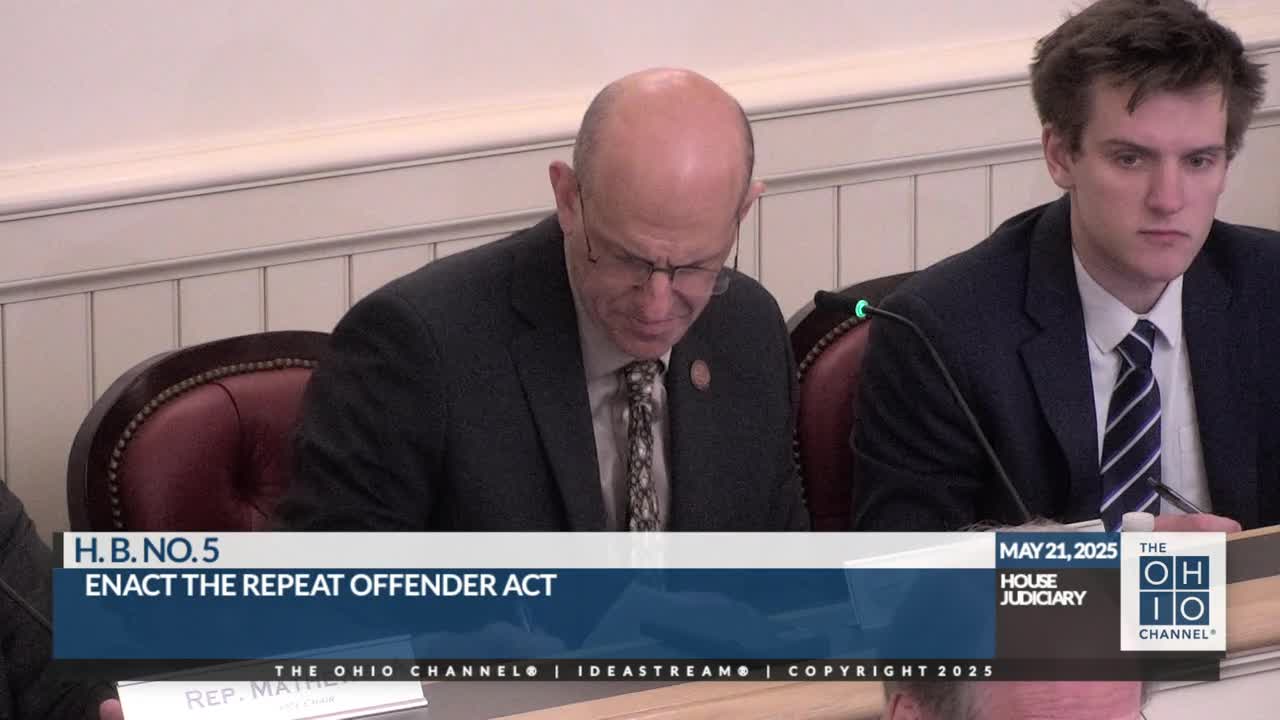
House Judiciary Committee advances changes to expungement process and weapons-under-disability penalties in House Bill 5
Summary
The Ohio House Judiciary Committee accepted a substitute to House Bill 5 that restores original penalties for firearms and suppressor offenses in some cases, revises the court notification process for sealing records, and drew opposition from the Ohio Association of Chiefs of Police over record retention and felony-class reductions.
Chair Thomas and the House Judiciary Committee accepted a substitute and then favorably reported House Bill 5 after sponsor and opponent testimony and a roll-call vote.
The substitute, offered by Representative Williams, restores original penalty specifications for certain automatic firearms and suppressors, increases penalties when a weapon is brandished or used during a crime, and changes how the court handles eligibility notices for record sealing. "So there's 2 main changes to the bill. First, we did, restore the original language as it relates to specifications for automatic firearms and suppressors," Williams said, describing increases to penalties when weapons are used in crimes and a new notification process for sealing eligibility.
The subbill replaces a requirement that courts schedule a mandatory hearing five years after eligibility for record sealing with a notice-based process. Under the substitute, the court will notify parties, including the defendant, that the person may be eligible to have their record sealed and will provide instructions on filing and an affidavit option for indigent filers. Williams told the committee that the change to notifications and other edits were made to reduce opposition and get interested parties on board.
Heinz von Ekersberger, chair of the legislative committee for the Ohio Association of Chiefs of Police (OACP), provided opponent testimony, saying the association supported portions of the bill that clarify restoration pathways but opposed two provisions. First, OACP asked that the bill not eliminate a requirement for the Ohio Bureau of Criminal Investigation (BCI) to maintain records of expunged convictions for law enforcement background checks; von Ekersberger said removing that access would "severely hinder our ability to ensure only individuals of the highest integrity are entrusted with the responsibilities and authority inherent with a position as a law enforcement officer." Second, OACP opposed wording that would reduce the degree of four qualifying violations under Ohio's weapons-under-disability statute from third-degree felonies to fourth-degree felonies, arguing that lowering classifications would be "counterproductive and sends the wrong message."
Representative Williams responded that the removal of retained expungement records was intended to align with federal recognition of expungement for restoration of firearm rights, citing a federal requirement and noting the substitute also lengthened the waiting period for eligibility from one year to seven years. Williams said the change was a trade-off intended to allow restoration of Second Amendment rights under federal standards.
After testimony, Vice Chair Matthews moved to favorably report House Bill 5. The clerk recorded the roll: Chair Thomas — yes; Vice Chair Matthews — yes; Ranking Member Isaacson — no; Representative Mohammed — no; Representative Odioso — yes; Representative Olslager — yes; Representative Plummer — yes; Representative Stewart — yes; Representative Swearingen — yes; Representative Synenberg — no; Representative Timbs — no; Representative Williams — yes. With sufficient votes, the committee favorably reported the bill and left the rule open until noon the same day.
No final enacted text or effective dates were set in the committee; the hearing concluded with direction that sponsors and law enforcement continue negotiations on the disputed provisions.