Get Full Government Meeting Transcripts, Videos, & Alerts Forever!
Get email alerts on the Healthcare Prior Authorization topic
No spam. Unsubscribe anytime.
Sponsor outlines changes to prior authorization process in House Bill 220 to limit retroactive denials and strengthen peer review
Summary
Representative Heidi Workman told the House Insurance Committee that House Bill 220 would clarify Ohio prior‑authorization rules to prevent retroactive denials, require same‑specialty peer reviewers, preserve 12‑month prior authorizations for chronic medications including dose changes, and bar insurers from charging providers to appeal denials.
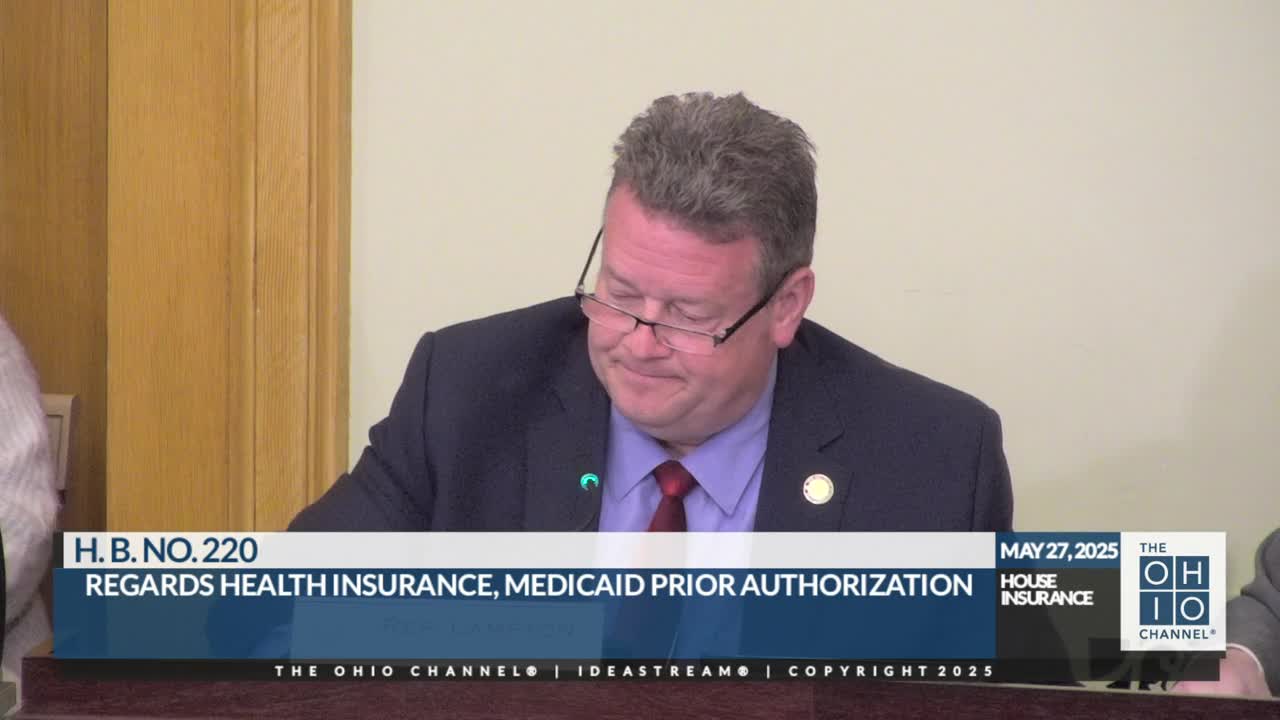
Representative Heidi Workman presented sponsor testimony on House Bill 220, describing the legislation as clarifying and strengthening existing Ohio law governing prior authorization for health care services.
Representative Heidi Workman said the bill “tightens Ohio's retroactive denial law to ensure that once a prior authorization is approved and the care is delivered, insurers cannot later deny payment,” and that it would “strengthen peer to peer review standards so that only appropriately credentialed physicians in the same specialty can conduct reviews and must respond promptly.” She said the bill would also “ensure that dosage adjustments for chronic disease medications do not invalidate a 12 month prior authorization” and would “prohibit health plans from charging providers for appealing a denial.”
Workman framed the bill as addressing administrative and patient harms. She stated survey-based figures, saying “Nearly 7,000,000 Ohioans live with at least 1 chronic disease,” and citing American Medical Association (AMA) survey results she summarized: “31 percent of physicians are reporting that prior authorizations are often or always denied,” “93 percent of physicians report care delays due to prior authorization,” and that practices complete “about 39 prior authorizations per physician per week,” which she equated to roughly “13 hours each week” of administrative time.
Committee members asked clarifying questions. Representative Sweeney asked about denial rates and whether prior authorization was primarily a cost-control tool. Workman replied that her denial-rate information came from AMA survey data and reiterated the survey percentages; she said the AMA data were limited and that further expert witnesses would provide more detail. Leader Jerrells asked about the practice of insurers charging providers to appeal denials and sought dollar‑amount specifics; Workman said she could not provide specific dollar figures and deferred to later expert testimony.
Workman characterized the proposed changes as clarifications to existing Ohio law—not an elimination of prior authorization—and said the aim is to reduce delays and administrative burden without removing insurers’ ability to require prior authorization.
No formal committee action on House Bill 220 was recorded in the transcript excerpt; the committee concluded the bill’s first hearing and moved on to House Bill 271.