Get Full Government Meeting Transcripts, Videos, & Alerts Forever!
Get email alerts on the Article V Convention topic
No spam. Unsubscribe anytime.
Committee hears testimony on Article V measures: delegate controls bill and joint resolution to seek limited convention
Summary
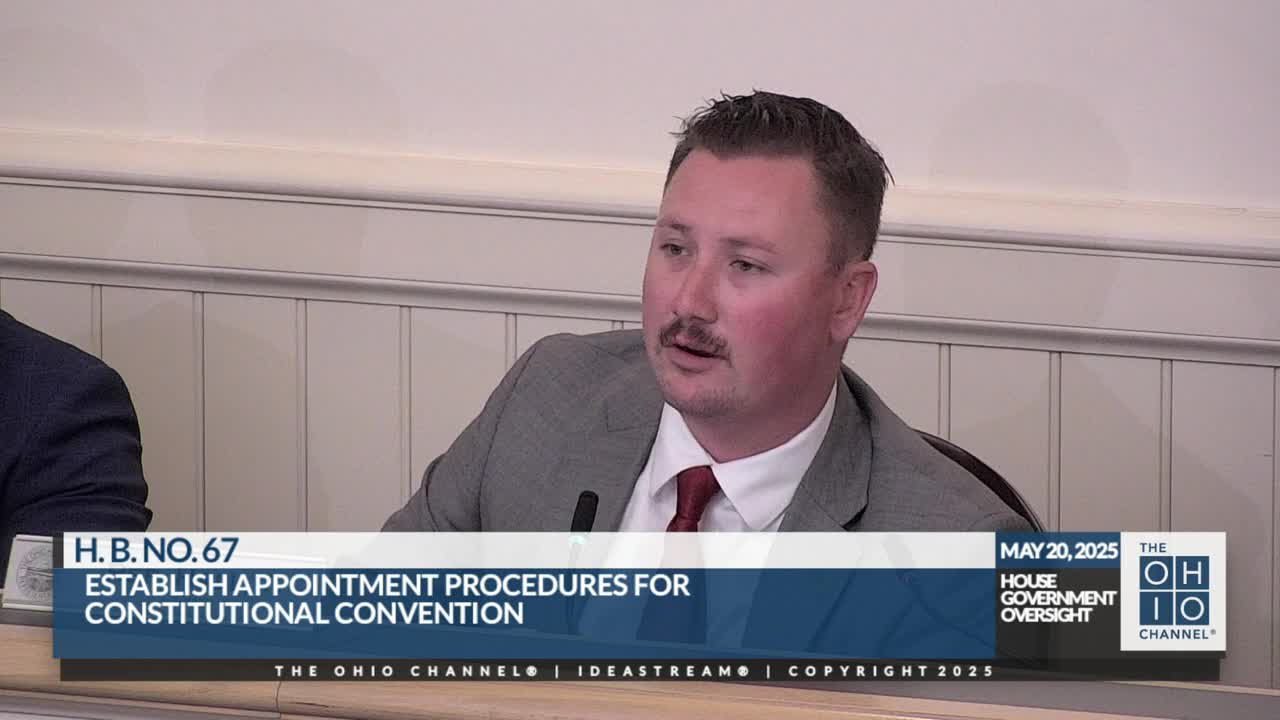
Lawmakers heard hours of proponent testimony on House Bill 67, which would set procedures for selecting and disciplining delegates to any Article V convention, and on House Joint Resolution 2, a proposed state application for a limited convention to consider fiscal restraints, limits on federal power and term limits.
Columbus — The House Government Oversight Committee took extended testimony on two related measures concerning Article V of the U.S. Constitution: House Bill 67, which would establish procedures for selecting, instructing and disciplining state delegates to any Article V convention, and House Joint Resolution 2, an application that would ask the states to call a limited convention on fiscal restraints, limits on federal power and term limits.
Supporters said the bills provide guardrails and a process for state participation in an amendments convention. Steve Jones, who testified as a petitioner and supporter, described HB 67 as providing “procedures regarding the selection, the instruction, the oversight of commissioners to any Article 5 amending proposing convention.” Jones recommended the committee advance the measure so Ohio would have a process in place if a convention is called.
Michael Farris, a constitutional lawyer and co-founder of the Convention of States Project, provided detailed constitutional and historical arguments in support of HB 67 and HJR 2. Farris told the committee the measures are aimed at ensuring delegates remain “faithful to the wise of opinions of the Ohio legislature and common sense Ohioans.” He described three key principles included in the delegate bill: that delegates be appointed and controlled by the state legislature, that conventions be limited to the agreed topic, and that each state have one vote at the convention. Farris said the legislation includes penalties, including removal and criminal prosecution, for “deliberate defiance of the limitations imposed by this legislature.”
“Whether it’s term limits or … federal spending limits, it applies to every convention on any topic at any time,” Farris said, describing HB 67 as a procedural measure rather than a substantive policy on any single issue.
Committee members asked legal and constitutional questions about enforceability, free-speech implications and proportional representation of delegates. Representative April Gross pressed witnesses on whether delegates could be considered federal agents once at a convention; Farris replied that delegates are agents of the state and cited the Supreme Court’s 2020 ruling in Chiafalo v. Washington concerning state control of presidential electors as precedent for state control of delegates.
Representative Erin Stevens questioned whether instructing and disciplining delegates could run afoul of the First Amendment; Farris said the bill addresses government speech and governmental agency limits and offered to work on drafting changes if needed. Several lawmakers raised proportionality concerns — whether a single-party legislature could appoint a slate of same-party delegates — and supporters said the bill sets minimum procedures but allows the General Assembly to add further rules in practice.
On HJR 2, proponents — including Bill Scott, Diana Tellis, Ed Mulholland, Roger Gibb and Susan Dunn — described why they support a limited convention focused on a trio of reforms: balanced-budget or fiscal restraints, limits on federal power and jurisdiction, and limits on terms of federal officials. Testimony included historical references, legal citations and repeated assurances that safeguards in the proposed measures prevent a “runaway” convention.
Farris and other witnesses cited the Article V ratification thresholds — that 34 states must apply for a convention on the same topic to trigger a convention and that 38 states must ratify any proposed amendment — and referenced case law and past litigation arguing that topic limits are binding. Supporters said their counsel had prepared legal analysis concluding the convention process can be limited and safe.
No committee vote was taken. Both measures had extended proponent testimony and question-and-answer. Committee members asked witnesses to return for follow-ups and suggested possible drafting amendments to clarify limits and enforcement mechanisms. Sponsors urged the committee to advance HB 67 and HJR 2 so Ohio would have appointment and oversight procedures in place if a convention application reaches the required number of states.