Get Full Government Meeting Transcripts, Videos, & Alerts Forever!
Get email alerts on the Article V Convention topic
No spam. Unsubscribe anytime.
Supporters tell Ohio panel Article V rules, delegate controls needed before any convention
Summary
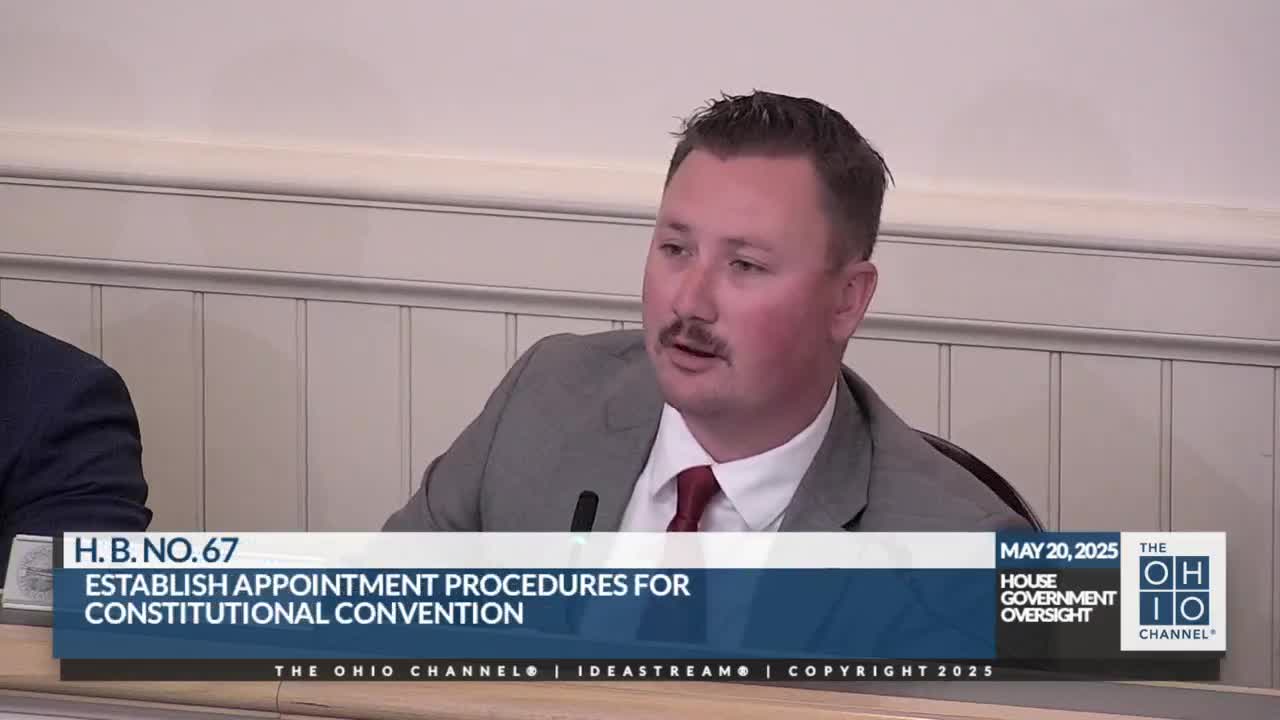
Proponents of House Bill 67 and House Joint Resolution 2 urged the Government Oversight Committee to approve procedures for selecting and disciplining state delegates and to pass an application for an Article V convention limited to fiscal restraints, limits on federal power and term limits.
At a long committee session, multiple witnesses told the House Government Oversight Committee that Ohio should both adopt a process to appoint and control delegates and add its name to a list of states requesting a convention under Article V of the U.S. Constitution.
Dr. Michael Farris, a constitutional attorney and co‑founder of the Convention of States Project, said HB 67 provides “procedures regarding the selection, the instruction, the oversight of commissioners to any Article 5 amending proposing convention.” He told lawmakers the state should have the authority to appoint, instruct and, if necessary, recall delegates and that the process should include penalties for deliberate disobedience of instructions.
Steve Jones, another proponent, said the bill was drafted after reviewing other states’ laws and argued Ohio needs a statutory process so delegates “be faithful to the wise of opinions of the Ohio legislature.” Bill Scott, Diana Tellis, Ed Mulholland, Roger Gibb and Susan Dunn also gave proponent testimony supporting HJR 2, the accompanying application to call a convention limited to three topics.
Why it matters: Speakers said the convention pathway is the constitutional mechanism for states to propose amendments when Congress does not act, and they argued a convention limited to fiscal restraints, limits on federal jurisdiction and term limits would address what they described as structural fiscal and governance problems in Washington.
Key claims and policy detail: Witnesses repeatedly said the Article V process requires 34 states to agree to the convention topic to call a convention, 26 state votes at the drafting stage to produce language at the convention (one‑state, one‑vote), and 38 states to ratify any proposed amendment. Dr. Farris said the convention should not be able to change its subject and emphasized a “one state, one vote” rule. Proponents said HB 67 would allow state legislatures to appoint, supervise, recall and, for willful violations, criminally sanction delegates.
Committee questions: Representative Gross and others pressed witnesses on constitutional limits, on whether delegates would become federal actors and how enforcement would function if delegates disobeyed instructions. Dr. Farris cited the U.S. Supreme Court decision in Chiafalo v. Washington about state control of presidential electors and argued state control over delegates is consistent with precedent. He also said historical and legal scholarship shows applications aggregate only by topic and that multiple safeguards exist through the multi‑stage ratification process.
Discussion vs. decision: The committee held multiple proponent testimonies and did not take a committee vote on either HB 67 or HJR 2 during this session.
Ending: Proponents asked lawmakers to advance HB 67’s delegate procedures and pass HJR 2’s limited convention application; committee members said they would review written submissions and could propose amendments addressing proportionality, time limits, or clarity on scope.