Get Full Government Meeting Transcripts, Videos, & Alerts Forever!
Get email alerts on the Term Limits topic
No spam. Unsubscribe anytime.
Committee Hears Proponents and Skeptics on Article V Term-Limits Resolution
Summary
Supporters of House Joint Resolution 3 urged Ohio to join a multi-state effort to press Congress for congressional term limits via an Article V convention; members pressed witnesses on legal risks, how a convention could be constrained, and whether Congress would instead preempt the effort.
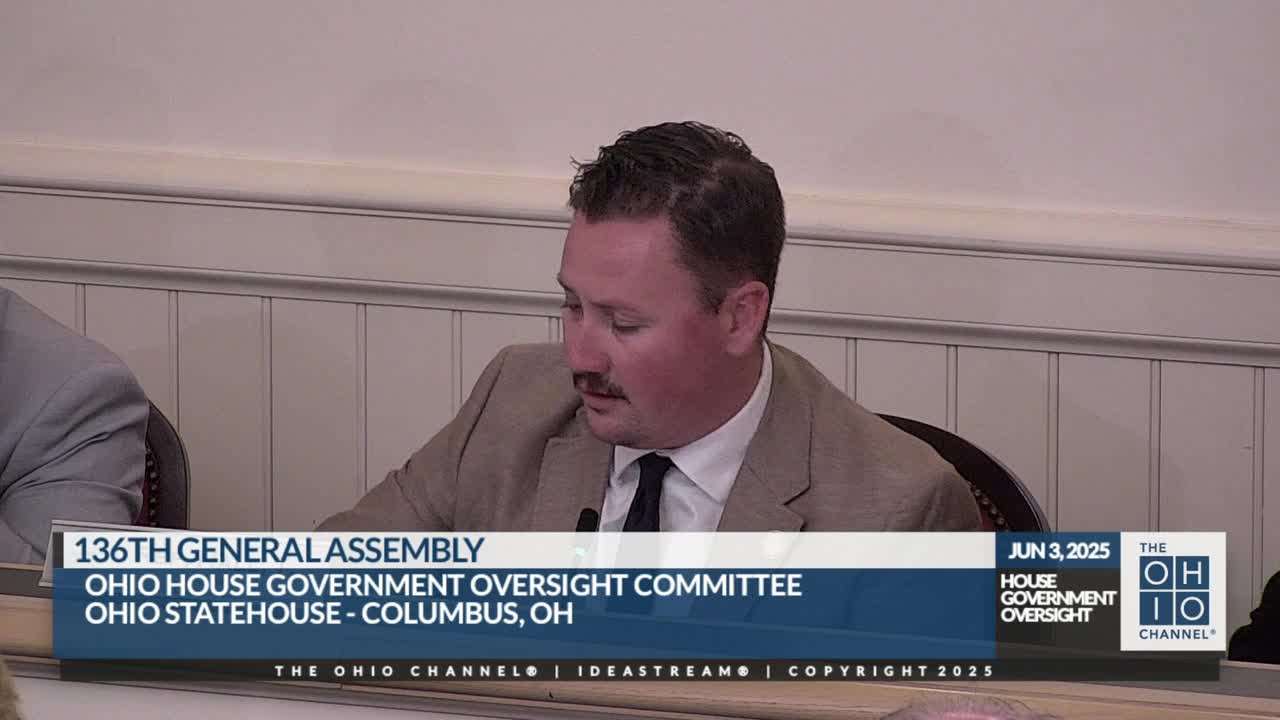
Kevin Coughlin, state chair of US Term Limits, told the House Government Oversight Committee that House Joint Resolution 3 would "give Ohio an opportunity to join with 12 other states in exercising its right to call for an Article 5 convention of the states limited to the issue of congressional term limits." He urged the committee to favorably report the measure during a second hearing that drew three witnesses from US Term Limits and extended questioning from committee members.
The debate centered on two competing claims: proponents said a coordinated set of state applications would pressure Congress to propose a term-limits amendment and likely grandfather current members, while several committee members raised legal and practical concerns about an Article V convention’s scope and enforceability. "History shows that the history of convention calls in our country results not in a convention, but in reluctant congressional action," Aaron Duquette, regional director for US Term Limits, said. "The overwhelmingly vast majority of these calls have been single topic, and the most successful of these efforts have resulted in Congress preempting the call by proposing an amendment themselves." Nick Tumbleides, chief executive officer of US Term Limits, said, "The runaway Congress is not a figment of our imagination. It's very real, and the American people understand this."
Why it matters: supporters argued the measure is a tool to address what they described as entrenched incumbency and low congressional responsiveness. Opponents and skeptical members pressed witnesses on legal risks, including whether delegates to a convention could ignore state instructions, whether a convention could be legally limited to one subject, and whether the U.S. Supreme Court has provided guidance on how an Article V convention would operate.
Committee questions focused on legal safeguards and precedent. Multiple members asked whether a convention could be reliably limited to a single subject and who would decide whether state applications were "substantially similar." Kevin Coughlin and other witnesses cited historical examples — including the Seventeenth Amendment and early state convention activity — to argue that convention calls have historically prompted Congress to act. Witnesses also acknowledged there is limited direct Supreme Court precedent on how a modern Article V convention would be administered. Representative Gross asked, "What would stop [delegates] from doing the same [as 1787] with an Article 5 convention pathway for term limits?" and cited concerns that delegates could exceed their instructions.
Witnesses stressed political dynamics as the most likely control on outcomes: they said Congress would probably propose and shape any amendment once it saw a sizeable number of state applications approaching the two-thirds threshold. "When citizen legislators like yourselves pass enough of these resolutions, Congress will be boxed into a corner and compelled to concede the fight by proposing the amendment," Duquette said. Several members pushed back, saying that uncertainty about convention rules and the absence of clear judicial guidance make the approach risky.
No formal committee vote on HJR 3 was recorded during the hearing. The testimony and questioning are part of the committee’s second hearing on the resolution; proponents asked the committee to advance the measure so Ohio could join other states applying for a convention under Article V of the U.S. Constitution.
The hearing record includes repeated references to polling cited by witnesses showing broad public support for term limits and to the number of states that had passed similar applications at the time of testimony.