Get Full Government Meeting Transcripts, Videos, & Alerts Forever!
Get email alerts on the Government Oversight Term Limits topic
No spam. Unsubscribe anytime.
Committee hears hours of testimony on Article V convention resolution for congressional term limits
Summary
Witnesses for US Term Limits urged the House Government Oversight Committee to favorably report House Joint Resolution 3, saying an Article V convention limited to congressional term limits would pressure Congress to act; lawmakers pressed witnesses on legal risks, control of a convention and whether the states’ applications can be constrained.
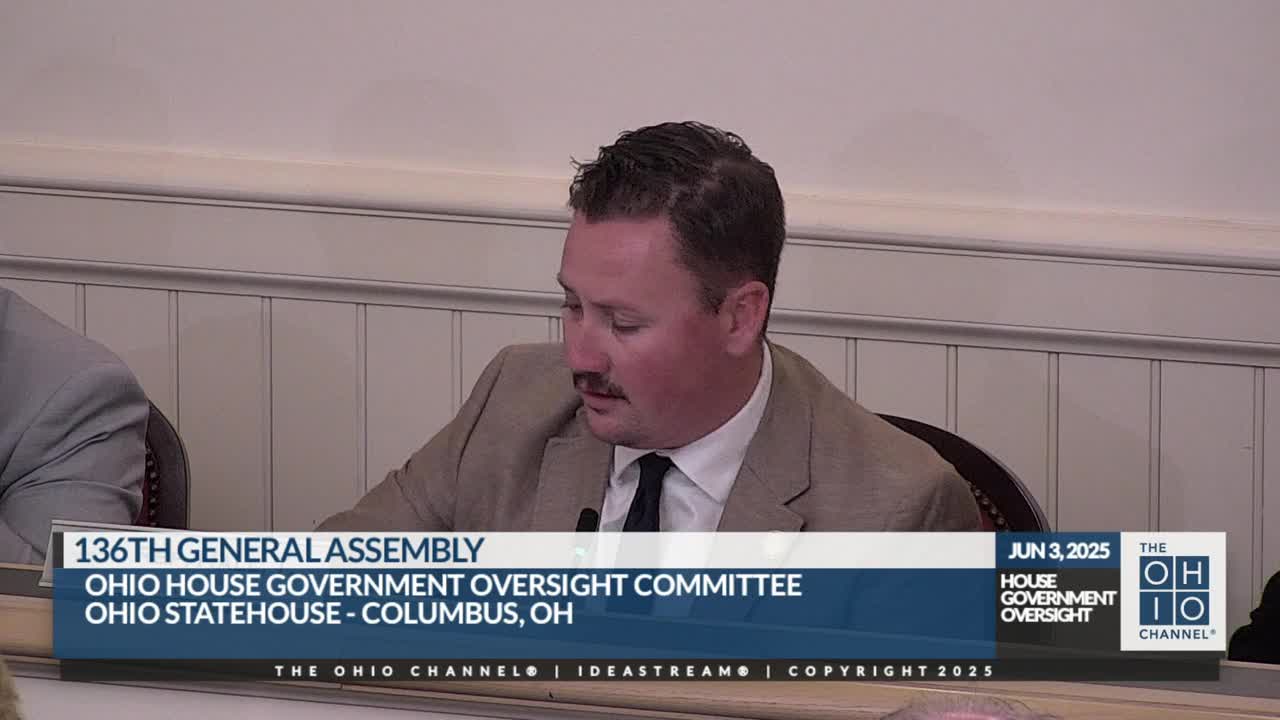
The House Government Oversight Committee on Wednesday heard more than two hours of testimony on House Joint Resolution 3, which would direct Ohio’s legislature to apply to Congress for an Article V convention limited to proposing an amendment that would impose term limits on members of the U.S. Congress.
Proponents told the committee that a convention limited to congressional term limits would be a political tool to force federal action. "HJR 3 gives Ohio an opportunity to join with 12 other states in exercising its right to call for an Article 5 convention of the states limited to the issue of congressional term limits," said Kevin Coughlin, state chair of US Term Limits. "When citizen legislators like yourselves pass enough of these resolutions, Congress will be boxed into a corner and compelled to concede the fight by proposing the amendment."
The resolution matters because supporters say it would pressure Congress to propose a constitutional amendment rather than leave the states to call a convention; opponents and some committee members warned about legal uncertainty and unintended consequences. "Could delegates ignore our instructions once we call a convention?" asked Representative Gross during questioning, referencing concerns that a convention could exceed a single subject or operate without public transparency.
Witnesses from US Term Limits framed the measure as a narrowly focused application that historically has prompted Congress to preempt state convention calls. "There will never be a convention," Aaron Duquette, a regional director for US Term Limits, said in testimony. "History shows that the history of convention calls in our country results not in a convention, but in reluctant congressional action." Nick Tumbleides, chief executive officer of US Term Limits, added, "The runaway Congress is not a figment of our imagination. It's very real, and the American people understand this."
Lawmakers pressed witnesses on several legal and practical points: whether an Article V convention can be constrained to a single subject; what entity decides whether state applications are "substantially similar"; whether delegates could act beyond state instructions; and whether the courts have provided clarity. Witnesses pointed to historical precedent and academic work they said supported the view that identical state applications constrain a convention’s subject and that, in practice, Congress has repeatedly responded to state pressure by proposing amendments itself. Committee members repeatedly asked whether the absence of definitive U.S. Supreme Court guidance and the example of the 1787 Philadelphia convention made the Article V path risky.
Witnesses and committee members also discussed polling and the number of states needed: proponents said the movement had support in public polls and that 34 states are required to trigger a convention, with 38 states required to ratify any amendment. The proponents said 11 states had already passed similar applications specifically on congressional term limits.
The hearing included questions from Representatives Groesch, Gross, Claggett, Troy, Simpson, Sims, Rader, King and Workman, among others. Committee members sought citations to legal scholarship and precedent; witnesses referenced academic work and historical episodes including the path that led to the Seventeenth and Twenty‑second Amendments as examples they said demonstrated how state pressure prompted congressional action.
No formal committee vote on HJR 3 occurred during this session; the committee concluded the second hearing and left the resolution pending further action. The record shows substantive engagement between proponents and members on constitutional risks, the mechanics of an Article V application, and how a national campaign of state applications might play out.
What’s next: The committee may schedule additional hearings, receive written submissions or move the resolution to a committee vote in a future meeting. Proponents asked members to favorably report the resolution so Ohio could join other states in the Article V application process.