Get Full Government Meeting Transcripts, Videos, & Alerts Forever!
Get email alerts on the Igaming Legalization topic
No spam. Unsubscribe anytime.
iGaming hearing draws casino operators and trade groups; witnesses press consumer protections, warn against high fees and tight license limits
Summary
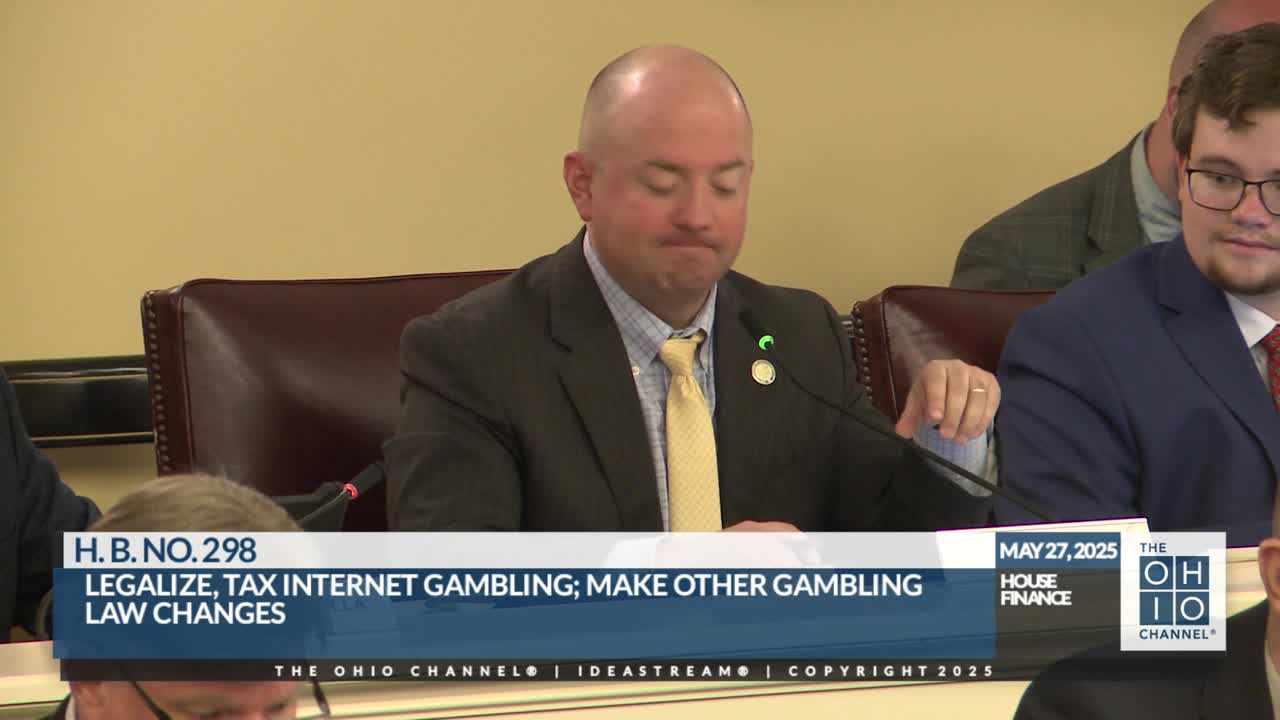
The House Finance Committee held a first hearing on substitute House Bill 298, a proposal to legalize regulated iGaming in Ohio tied to in‑state casinos and racinos.
The House Finance Committee convened a lengthy first hearing on substitute House Bill 298, a proposal to legalize online casino gaming (iGaming) tethered to Ohio’s land-based casino and racino operators. The hearing drew witnesses from trade groups, online operators and casino companies who discussed consumer protections, illegal “sweepstakes” sites, taxation, license fees and market structure.
Scott Ward of the Sports Betting Alliance told the committee that an unregulated illegal market already exists in Ohio and urged the legislature to create a regulated alternative. Ward said legalization would “provide consumer protections to Ohioans, who already engage in iGaming, stamp out illegal online gaming happening in the state now, and provide significant tax revenue without raising taxes.” He cited a study he summarized as estimating roughly $5,000,000,000 annually is currently spent on illegal online casino gaming in Ohio and said experience in Pennsylvania and Michigan shows the legal market can capture a meaningful portion of that activity.
Industry witnesses and trade groups emphasized responsible-gaming tools and real-time monitoring as consumer protections that a regulated market would enable. Cesar Fernandez, head of state government relations at FanDuel, said FanDuel offers “limits on deposits, time spent gaming, and self exclusion options,” and told the committee iGaming in other states has produced substantial tax revenue; he estimated iGaming “can contribute more than $600,000,000 in annual tax revenue.” Scott Ward and other witnesses also described identity verification, exclusion lists and other controls used by licensed operators to keep minors and problem gamblers from participating.
Several witnesses warned the committee that proposed licensing and tax mechanics in the draft bill could limit competition and reduce the legal market’s ability to displace illegal operators. Multiple trade witnesses and operators said a $50,000,000 franchise or platform license fee and a small cap on mobile brands (7 platforms) are unusually high or restrictive; Fanatics, Boyd Gaming, Play and Go and the industry trade group IDEA all urged the committee to lower licensing barriers, allow more operator “skins” or otherwise reduce costs to promote a larger, more competitive legal market. Brent Iden of Fanatics and others pointed to Michigan and Pennsylvania as examples where many brands operate and generate both competition and state revenue.
Witnesses also discussed problem-gambling data and social impacts. Several said the commonly cited increase in calls to gambling help lines after legalization reflects broader consumer contact with regulated firms (account setup, customer service) and is not a direct measure of problem gambling. Scott Ward and others cited the National Council on Problem Gambling, and witnesses recurring theme was that regulation can identify risky behavior more effectively than the illegal market. Operators described internal monitoring and intervention protocols: “you’re gonna be contacted by the company, and saying, hey, you know, is this something you wanna be doing? … offering responsible gambling tools,” one witness said.
Other issues raised included: whether promotions should be tethered to specific brick-and-mortar partner facilities (several operators said that requirement would reduce competitiveness), whether the bill’s prohibition of credit-card funding and some bonus activity should remain, and whether constitutional limits tied to Ohio’s brick-and-mortar casino authorizations require special handling. Committee members questioned witnesses about empirical effects on brick-and-mortar employment and local revenues; operators and casinos urged the committee to consider market structure and long-run revenue effects rather than assuming cannibalization.
No formal committee vote on HB 298 occurred at the hearing; the sponsor and multiple witnesses committed to supplying additional data and analyses on market size, revenue projections, licensing design and problem-gambling metrics. Several witnesses asked the committee to adjust license fees, tax treatment of promotions, and the cap on platforms to attract more operators and better compete with the illegal market.