Get Full Government Meeting Transcripts, Videos, & Alerts Forever!
Get email alerts on the Workforce Development topic
No spam. Unsubscribe anytime.
House bill would fund local 'Community Connectors' to link students with jobs, sponsors say
Summary
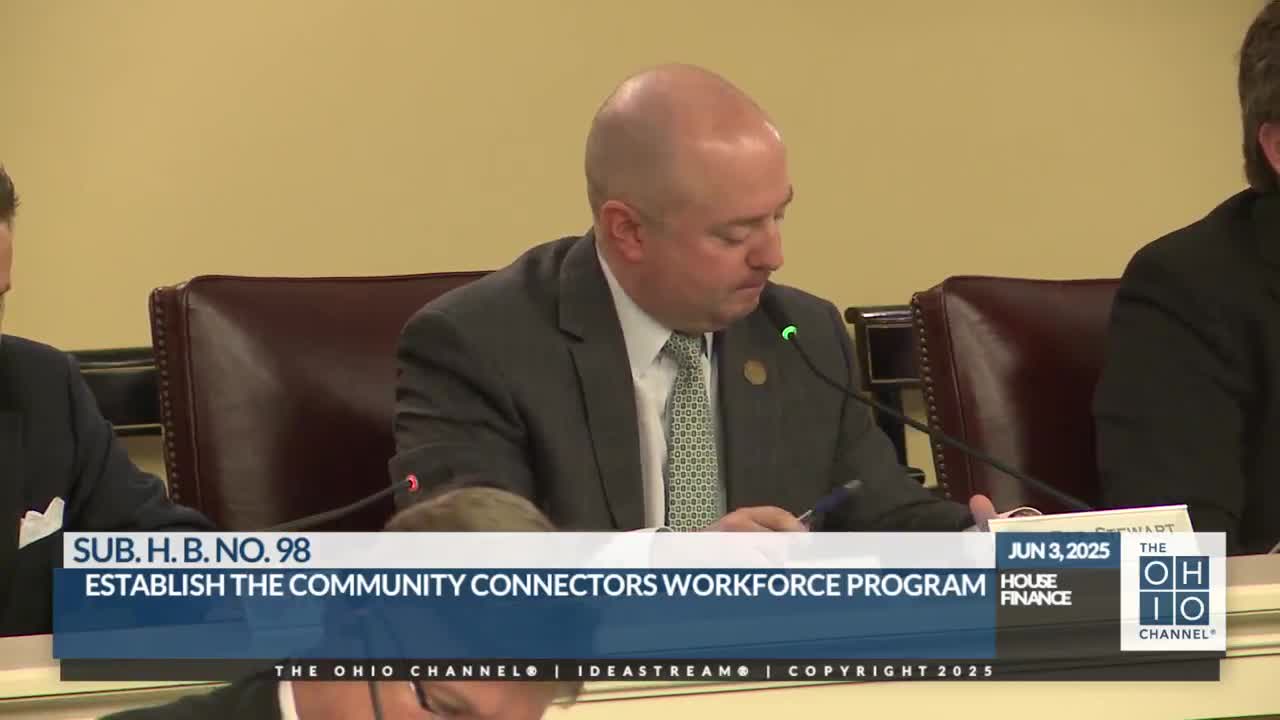
The House Finance Committee heard sponsor testimony on substitute House Bill 98, which would place job coordinators at Educational Service Centers to recruit and prepare high‑school students for internships, apprenticeships and entry‑level employment.
The House Finance Committee heard sponsor testimony on substitute House Bill 98, which would establish a Community Connectors Workforce Program to place job coordinators at Educational Service Centers (ESCs) to help high‑school students access internships, apprenticeships and entry‑level jobs.
Representative Santucci, the bill’s lead sponsor, said the program’s purpose is "to identify available jobs and to prepare students to help employers fill their workforce needs." Santucci told the committee the Department of Education and Workforce would oversee the program and ESCs would administer it through contracts with school districts.
Under testimony from Santucci and co‑sponsor Representative Williams, the proposal would allocate $8,000,000 each fiscal year. Sponsors described an allocation rule: half of the appropriation distributed equally among ESCs to ensure each could employ or contract a program director, and the remaining half allocated to ESCs proportionally by student count. The program would emphasize classroom instruction in soft and professional skills — problem solving, time management, communication and workplace ethics — together with collaboration with OhioMeansJobs and local business advisory councils to identify openings and match students.
"This program will involve collaboration with local OhioMeans job centers and community partners to fill those available jobs, internships, and apprenticeships," Representative Santucci said. Representative Williams described the connectors as "a dedicated job coordinator at the educational service center recruiting those students, bringing them to the table, and then going through the OhioMeansJobs website and identifying roles and being kind of that matchmaker." Sponsors said the primary focus would be on eleventh‑ and twelfth‑grade students but that programs could adapt to local needs and ages where appropriate.
Committee members asked how the Community Connectors program would differ from existing OhioMeansJobs centers and business advisory councils. Sponsors said the connectors would be proactive, embedded at ESCs and schools, and would actively recruit and prepare students for work, rather than passively listing openings. Representative Ray and others emphasized that OhioMeansJobs performs job posting and training functions; sponsors said the connector’s role is to bridge schools and employers with direct outreach to students.
Members also asked about support for structural barriers such as transportation, access to digital tools, and food security. Sponsors stated the bill does not contain specific line items for these wraparound services but described connectors as collaborators who could marshal local resources, including food banks and existing transportation programs. Committee members suggested follow‑up to define how ESCs would coordinate supportive services where needed.
Sponsors said the program previously advanced in other committees in the past General Assembly and received support from multiple ESCs. No formal action or vote occurred in this hearing; sponsors welcomed committee questions and further drafting.
Why it matters: supporters told the committee the program seeks to reduce youth unemployment, prepare students with workplace skills, and provide employers with a pipeline of entry‑level workers as part of broader workforce development efforts in Ohio.