Get Full Government Meeting Transcripts, Videos, & Alerts Forever!
Get email alerts on the Hb 142 Rate Reform topic
No spam. Unsubscribe anytime.
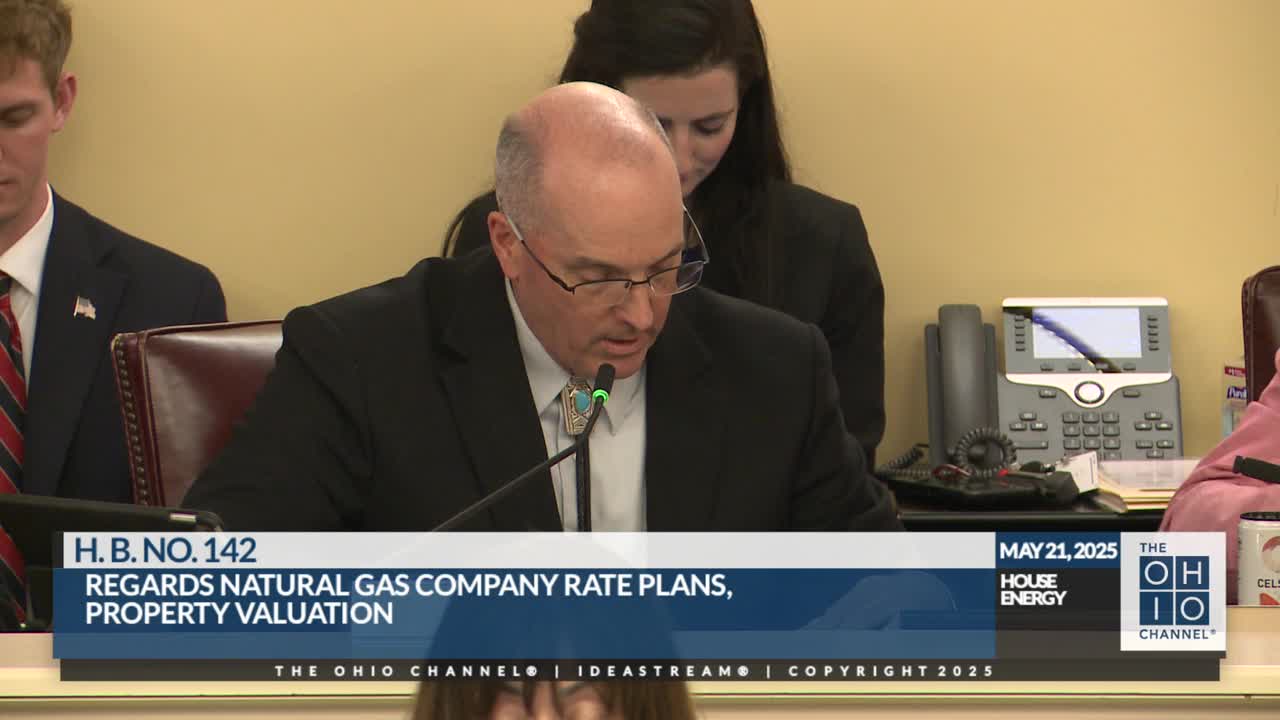
House Energy Committee hears broad opposition to House Bill 142 over settlements, forecasted rates and consumer protections
Summary
Opponents told the House Energy Committee that House Bill 142 would codify a PUCO settlement standard that weakens scrutiny of utility deals, expand forecasted test years and riders for gas companies, shorten review windows and remove refund rights — moves they say would shift costs to consumers.
Columbus — On Wednesday the House Energy Committee took opponent testimony on House Bill 142, a rate‑making and energy policy bill that witnesses said would change how the Public Utilities Commission of Ohio (PUCO) reviews settlements, let gas utilities use expanded forecasted test years and riders, shorten PUCO review windows and limit consumer refunds.
Karen Nordstrom, clean energy attorney for the Ohio Environmental Council Action Fund, told the committee she opposes the bill’s proposed codification of the PUCO stipulation standard in section 4,903.3 because, she said, the three‑pronged test “functionally operates to rubber stamp settlements between utilities, intervening parties and commission staff.” Nordstrom said the practical effect is to shift the burden of proof onto parties that oppose a settlement and to insulate confidential settlement talks from meaningful scrutiny.
The Ohio Manufacturers Association (represented by Kim Boiko, partner at Carpenter Lipps, testifying for the OMA Energy Council) said the bill would expand forecasted test periods to natural gas companies and create multiple “date certain” deadlines that would allow utilities to put projected rates in effect immediately and adjust later. “Forecasted test periods allow utilities to project future costs and revenues which can result in consumers paying higher rates based on speculative estimates rather than actual verifiable data,” Boiko said. She told the committee the bill also would let utilities collect money for projected capital expenditures and retain it even if the investments are not ultimately used as planned.
Maureen Willis, Director of the Ohio Consumers’ Counsel (the state agency representing residential utility consumers), said HB 142 goes “far beyond” the protections and tradeoffs included in House Bill 15 and would leave consumers with fewer safeguards. Willis said the bill preserves and enlarges riders and alternative rate‑plan features that already exist for gas utilities and would, among other changes, shorten the PUCO’s review deadlines, limit rehearing and appeal rights and remove refunds for customers when rates are later found unlawful. “HB142 hands gas utilities even more power while sticking consumers with the bill,” Willis said.
Witnesses pointed to several specific provisions and consequences under HB 142 that drew bipartisan questions from committee members: the bill’s settlement language (which opponents said would require a utility’s support before the commission may consider a settlement), expanded forecasted test years and multiple date‑certain options for projected investments, automatic approval rules if the PUCO does not act within shortened shot clocks, and a curtailed true‑up process that opponents said looks only at plant and capital structure and omits expense and profit true‑ups.
Willis offered numbers she said illustrate the stakes: she testified that Columbia Gas’s capital investment recovered through riders is approximately $1,800,000,000 and that Columbia’s fixed residential delivery charge rose from $16.75 to $34.65 over time; she said Dominion’s fixed charge rose from $17 to $43. Willis also said OCC estimated Dominion’s actual cost of debt in 2019 was 2.29 percent while Dominion charged 6.5 percent in rider calculations, a difference OCC estimated cost consumers about $97,000,000 from 2020 to 2025.
Committee members asked witnesses how the bill compares with HB 15 — the recent electric utility reform — and whether elements of HB 15 (for example, a complete annual true‑up and elimination of riders for electric utilities) could be applied to gas utilities in a way that balances speed and scrutiny. Boiko and Willis both said gas utilities already have alternative regulation and riders that give them advantages the electric sector did not previously hold, so any expansion should be paired with stronger consumer protections and a robust true‑up process.
No committee votes or formal actions were taken at the hearing. Witnesses said they are willing to work with committee members on amendments: Willis and Boiko offered to provide written lists of specific provisions and suggested language following the hearing.
The committee concluded the third hearing on House Bill 142 with no further testimony scheduled; the bill’s sponsors and the PUCO were not represented among the opponent witnesses at this session.