Get Full Government Meeting Transcripts, Videos, & Alerts Forever!
Get email alerts on the Brownfield Remediation Funding topic
No spam. Unsubscribe anytime.
Committee hears bill to create stable funding and merit review for brownfield cleanup program
Summary
Representatives Hall and Sweeney presented House Bill 93 to dedicate funding to Ohio’s Brownfield Remediation Program, propose merit‑based application changes, and revisit county set‑asides; committee members pressed for accountability metrics and geographic distribution safeguards.
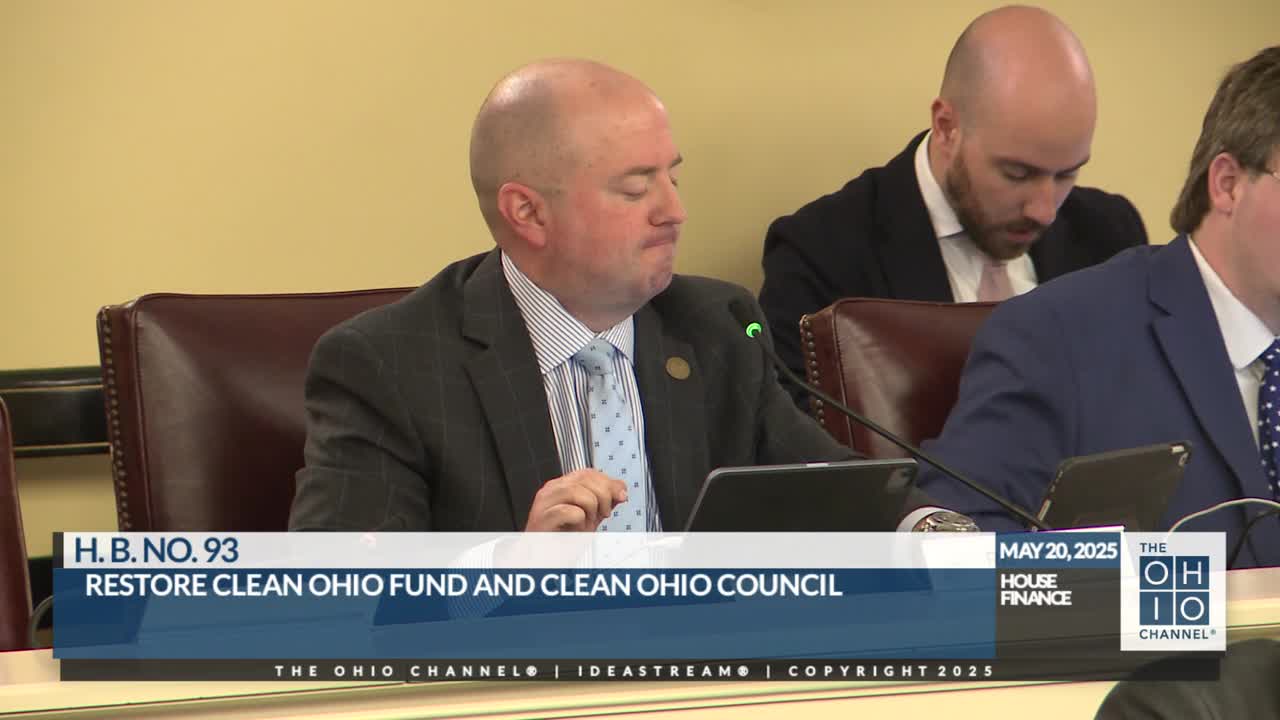
Representatives Hall and Sweeney presented sponsor testimony on House Bill 93 to the House Finance Committee, proposing a framework to establish a stable funding stream and program reforms for Ohio’s Brownfield Remediation Program.
The bill would earmark a portion of excess liquor franchise profits that JobsOhio returns to the state as a dedicated funding source for brownfield remediation instead of relying on two‑year reappropriations. Sponsors said the intent is to provide reliable funding for multi‑phase remediation projects and to change the application process away from a first‑come, first‑served portal toward a merit‑based, rolling submission evaluated on project readiness and community benefit. Testimony proposed reviving a version of the Clean Ohio Council to guide merit evaluation, supported rolling intake and revisions, and discussed possible county set‑asides to ensure geographic spread.
Sponsors noted the State Operating Budget included a $250,000,000 appropriation to the Brownfield Remediation Fund, but argued that allocation rules in recent budgets allowed a few counties to capture large shares (Cuyahoga County reportedly received about 35% in a recent cycle) because of speed of application, not project merit. Committee members asked whether HB93 includes accountability and longitudinal evaluation measures; sponsors said reporting and coordination with the Department of Development could provide outcomes data and invited committee input to add specific reporting language. They also said current law provides a $1,000,000 per‑county set‑aside but noted not all counties used the set‑aside and that the bill as presented did not fix the exact set‑aside amount.
Representatives asked about mechanisms to prevent rapid portal‑based capture of funds and to ensure funds support projects that proceed to cleanup rather than assessments only. Sponsors said they favor merit‑based review, rolling intake, revisiting set‑aside levels, and working with the Senate and program stakeholders to finalize a model. No committee vote occurred; sponsors asked for continued stakeholder input and collaboration.