Get Full Government Meeting Transcripts, Videos, & Alerts Forever!
Get email alerts on the Childcare topic
No spam. Unsubscribe anytime.
Sponsors pitch employer-led grants to build on-site and near-site childcare
Summary
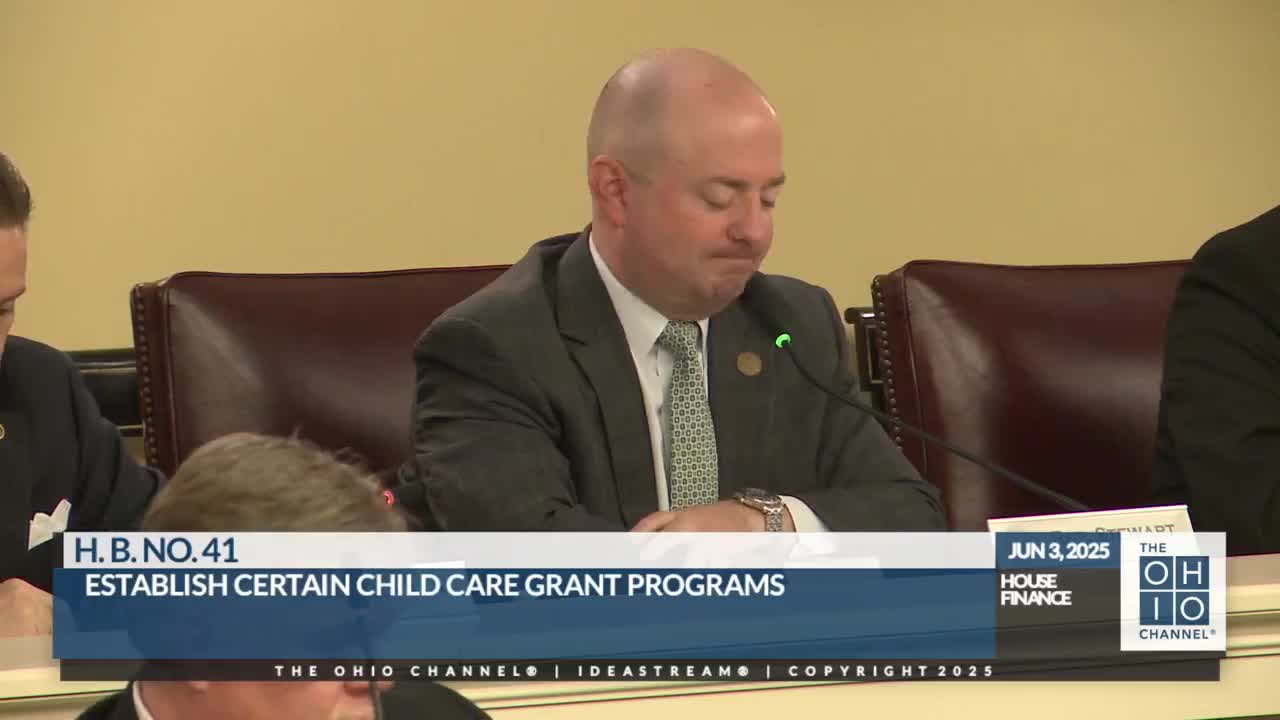
The House Finance Committee heard sponsor testimony on House Bill 41, a proposal to create state grants that would help employers, nonprofits and local partners develop on‑site or near‑site child care to improve workforce participation and reduce costs for working families.
The House Finance Committee heard sponsor testimony on House Bill 41, a proposal to create state grants that would help employers, nonprofits and local partners develop on‑site or near‑site child care to improve workforce participation and reduce costs for working families.
The bill’s sponsors, Representative White, and Representative Romer, told the committee the program would fund public‑private partnerships and training to help businesses convert unused office or campus space, or otherwise collaborate with local child‑care providers, to bring child care closer to employees.
Supporters say the proposal is intended to address two linked problems: rising child‑care costs and worker shortages. "This legislation is about stimulating new public private partnerships to help our businesses, our community partners, our childcare providers and others work together to increase access to on‑site or near site childcare," Representative White said in opening testimony. White cited statewide figures about affordability and workforce strain and noted center‑based child care averages "$9,580 to $12,351 per year," depending on a child’s age.
Representative Romer offered details about how the program would operate: a competitive grant program with a sustainability requirement for applicants, cohort technical assistance, and a toolkit for employers that want to provide payroll or other benefits to employees. "What we're looking at doing is essentially a public private partnership. This would involve the state making an investment," Romer said, describing grants, training, and community cohorts to bring employers and providers together.
Sponsors proposed a grant cap in the bill text of up to $750,000 per award and said the statute as drafted authorized $10,000,000 per year for the program; sponsors told the committee they intend to scale that figure down and emphasized the program is a grants‑based startup fund rather than an ongoing entitlement. Romer said the grants would be flexible—funding build‑outs, vehicles, fencing, or other local needs—and applicants would have to show a plan for sustainability.
Committee members pressed sponsors on eligibility and prioritization. Speaker Pro Tem Gil Manning and Representative Williams asked whether the statute gives priority to employers over other entities; sponsors said the intent is employer‑led solutions but the text allows local flexibility so governments, nonprofits, colleges or coalitions that organize employers could also apply. Sponsors cited an Ashland example in which businesses and a nonprofit collaborated to build a center in an industrial park.
Several members asked about administrative burden and reporting; Representative Tom Young said he wanted a simple, low‑compliance process. Sponsors agreed the program should minimize regulatory friction and said participants would receive best‑practice training. Representative Schmidt and others asked whether businesses would be required to provide financial contributions; sponsors said many successful projects include employer “skin in the game” but that the grant program was designed to support a range of local models.
Because questions remained and members had additional items on the agenda, Chairman Stewart deferred consideration of HB 41 to the committee’s next meeting. The bill was not voted on during this session.
Why it matters: sponsors and witnesses framed HB 41 as a workforce and affordability measure that aims to expand child‑care capacity near employers to reduce absenteeism and help parents remain employed. The committee will revisit details including grant prioritization, the annual appropriation level, and eligibility language.