Get Full Government Meeting Transcripts, Videos, & Alerts Forever!
Get email alerts on the Employment Verification topic
No spam. Unsubscribe anytime.
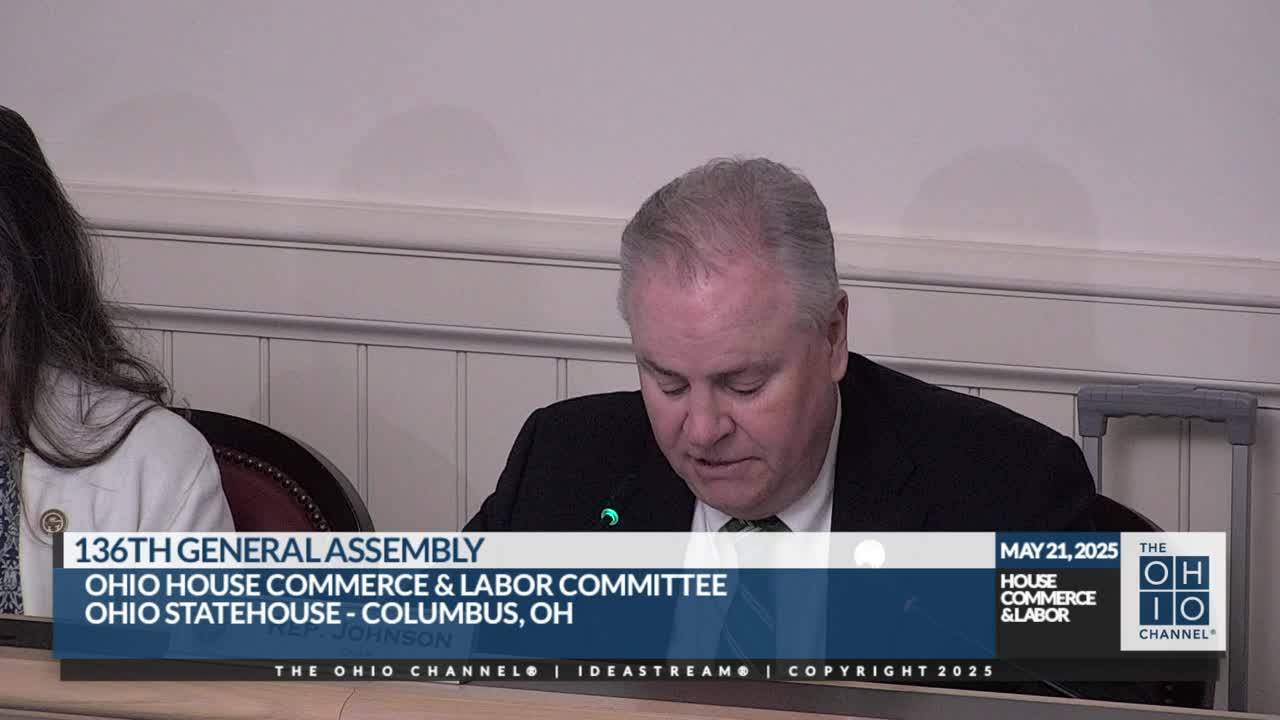
Committee adopts amendment to HB 246 after proponents push for E‑Verify for construction jobs
Summary
House Bill 246 (third hearing) drew proponent testimony from union organizers urging mandatory use of the E‑Verify system on construction projects and tighter penalties for contractors who repeatedly employ undocumented workers.
House Bill 246 (third hearing) drew proponent testimony from union organizers urging mandatory use of the E‑Verify system on construction projects and tighter penalties for contractors who repeatedly employ undocumented workers.
Richard Ochocchi, lead organizer for the Ohio State Association of Plumbers and Pipefitters, told the Commerce and Labor Committee that undocumented labor “has been steadily increasing” across major Ohio cities and that undocumented workers do not pay into state systems. “For every undocumented worker, we are robbing our state and municipalities of tax dollars and allowing the contractors that are playing by the rules to be undercut by labor brokers,” Ochocchi said. He added, “I strongly urge your support for House Bill 246.”
The nut graf: proponents said HB 246 would protect taxpayers, raise workplace safety and create more level competition for contractors by requiring a check of legal work status; the committee approved a technical amendment clarifying disqualification and hearing procedures for contractors and labor brokers accused of repeated violations.
Details and context
Kelly Lipinski, special representative with the United Association of Plumbers and Pipefitters, offered field data supporters said showed a substantial undocumented presence in the construction trades. She told the panel that in a multi‑city organizer effort “of the 573 plumbers, pipefitters that gave us their contact information, 30% of these workers were undocumented,” and she said undocumented workers were present in residential, commercial and industrial sectors across Ohio.
On questions from Representative White about safety, witnesses said that legally documented workers are more likely to report on‑the‑job injuries and follow OSHA reporting, and that the presence of legally authorized workers improves jobsite safety. Ochocchi: “I do believe this would increase safety… This will allow them to… report it. And I think it would increase our safety and the safety of the workers.”
Formal action taken
Representative Fisher moved to adopt Amendment 507‑1 to HB 246, which the mover described as clarifying how a contractor, subcontractor, or labor broker is removed from a list of disqualified entities, clarifying the time to request a hearing, and providing that an attorney general determination of two or more violations could disqualify the firm from state contracts for up to two years. The committee proceeded without objection; the amendment was made part of the bill by unanimous consent. The transcript records the committee concluding the third hearing on HB 246; no final committee vote on the bill itself appears in the record.
Discussion vs. decision
Discussion: proponents presented field observations and safety arguments; members asked questions about workforce supply, safety, and contractor practices. Decision: the committee adopted Amendment 507‑1 by unanimous consent; there was no recorded vote on passage of the underlying bill in this hearing.
What the record does not show
The committee record in the transcript does not include a roll‑call vote on the underlying bill, nor does it contain an enacted statutory text; the amendment was agreed to without objection during the hearing.
Ending
With the amendment incorporated, the committee closed the third hearing on HB 246 and moved on to other agenda items. Further committee action or a floor vote on the bill is not recorded in the provided transcript.