
Ohio lawmakers hear testimony on bill to classify platform-based health workers as independent contractors
Get AI-powered insights, summaries, and transcripts
Subscribe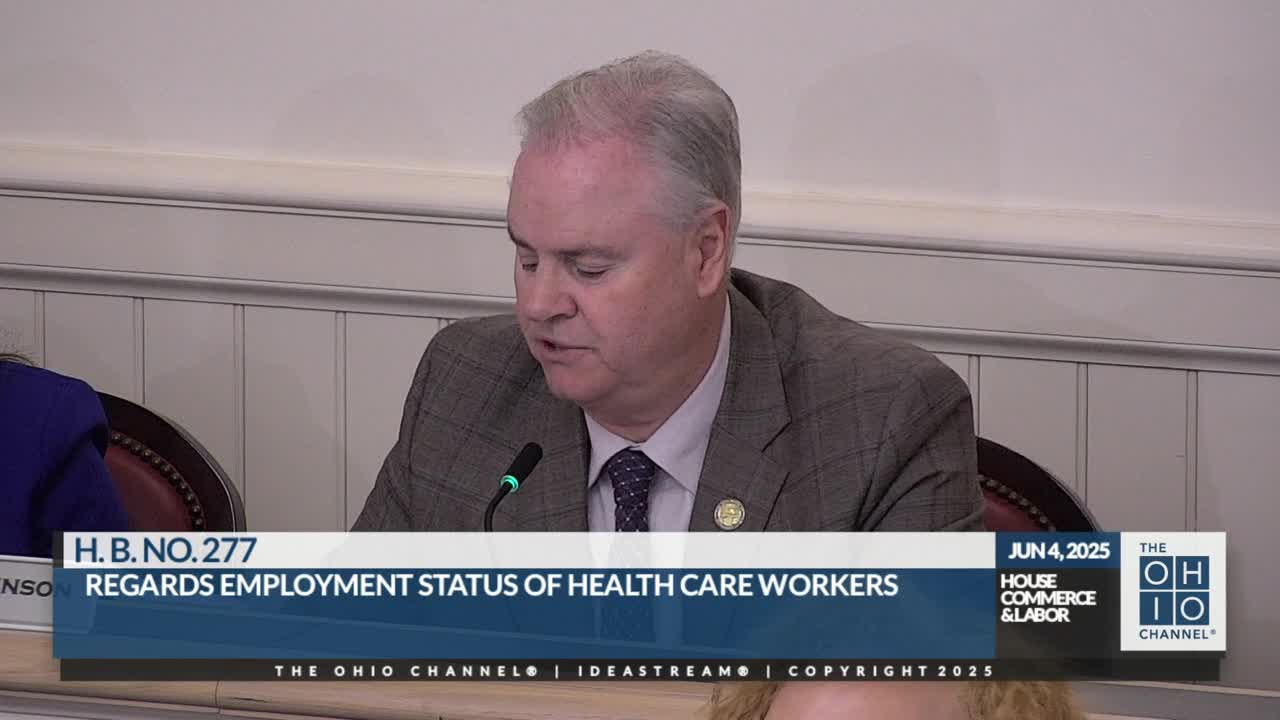
Summary
Representatives introduced House Bill 277 in the Ohio House Commerce and Labor Committee on first hearing, proposing that health care workers who sign contracts with electronic staffing platforms be treated as independent contractors for employment-law purposes.
Representatives introduced House Bill 277 in the Ohio House Commerce and Labor Committee on first hearing, proposing that health care workers who sign contracts with electronic staffing platforms be treated as independent contractors for employment-law purposes.
The proposal, presented by Representative Craig and co-sponsor Representative Dieter, would set criteria under which a person using a health care worker platform qualifies as an independent contractor rather than an employee. "This is my first time before this committee…House Bill 277 responds directly to the mounting pressures faced by the nursing profession and the broader health care workforce," Representative Craig said in sponsor testimony. Representative Dieter added that the bill lists criteria including that a worker need not accept a minimum number of shifts, may freely accept or reject shifts, may work for other platforms or facilities and cannot be required to sign noncompete agreements.
The bill’s sponsors and committee members repeatedly described the measure as permissive. "This bill is permissive…these nurses, health care professionals, there is no requirement for them to sign an agreement with a health care platform," Representative Dieter said. Sponsors said platforms require background checks and credential verification for participants.
Committee members pressed sponsors on several practical and legal concerns. Ranking Member McNally asked whether use of in-house scheduling systems could unintentionally convert existing employees into 1099 workers under the bill’s broad definition of "platform." Representative Dieter said that is not the intent and that the bill’s drafting team would tighten language to prevent such an outcome. Representative McNally also asked whether platforms would relieve employers of payroll taxes, workers’ compensation obligations and overtime protections; sponsors said they would obtain clarification on those points from Legislative Service Commission (LSC). Representative Brent raised concerns that the bill could exempt platform workers from overtime and minimum-wage protections and asked who would benefit from such changes. Representative Brent said, "I wanna know why and who does that benefit when we take away the overtime provisions for these health care workers?" and asked staff to identify the statutory text.
Lawmakers also asked whether the bill would allow employers to circumvent collective bargaining agreements by reclassifying unionized employees. Representative Rader asked, "are there any protections or anything in this bill to prevent employers specifically from using platform classifications as a workaround to avoid collective bargaining agreements?" Sponsors responded that the bill is voluntary for workers and that it does not prohibit union membership.
Members asked about scope and populations affected. Representative White, citing family members in health care, asked whether the bill’s definition would include unlicensed direct-care staff such as nursing assistants; sponsors confirmed that the bill’s definition at line 609 includes both licensed and nonlicensed health care workers who provide direct care through a health care worker platform. Sponsors emphasized the bill would not permit interchange of licensed providers with unlicensed workers for roles requiring licensure; instead the platforms would supply workers for the appropriate category of shift.
No committee vote was taken; the item concluded as a first hearing with sponsors taking questions. Committee members requested clarifications from sponsors and LSC on overtime, minimum-wage treatment, workers’ compensation coverage and the potential interaction with in-house scheduling platforms.
The committee’s discussion is likely to shape amendments before any subsequent procedural vote.