Get Full Government Meeting Transcripts, Videos, & Alerts Forever!
Get email alerts on the Education Policy topic
No spam. Unsubscribe anytime.
Local residents debate private-school vouchers and public-school funding with lieutenant governor
Summary
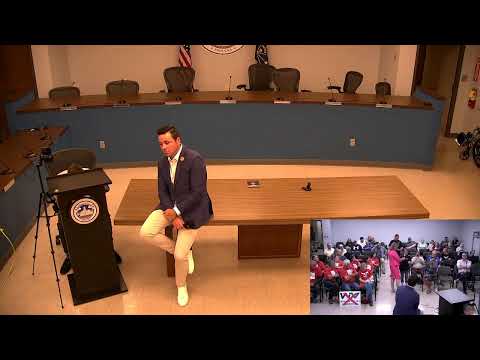
At the town hall, residents and Lt. Gov. Micah Beckwith debated Indiana’s scholarship-voucher programs, state education spending and charter-school standards; a resident cited $497 million in vouchers last year and projections toward $1 billion in coming years, and Beckwith defended parental choice and competition in education.
John Fordore, a lifelong Vigo County resident, told Lieutenant Governor Micah Beckwith that state spending on private-school vouchers has grown sharply and questioned whether the state can sustain the trend. "Last year, the state of Indiana gave out $497,000,000 in vouchers for private schools. It is estimated that in the next five years that number will be $1,000,000,000 plus," Fordore said. "How long can we keep doing this?"
Beckwith defended school-choice measures and argued that vouchers introduce competition into what he described as a former public-school monopoly. He said voucher programs can benefit inner-city families who want alternatives to failing neighborhood schools and suggested tax breaks as an alternative mechanism to support private-school parents. "If there are some families in the state that wanna send their kids to private schools, it's gonna help them," he said.
The back-and-forth touched on student-teacher credentialing in charter and private schools, property-tax funding for public education and the share of the state budget devoted to education. Fordore and others said taxpayers subsidize the public system even when some families use vouchers; Beckwith said taxpayers can choose to direct additional voluntary funds to public schools and argued competition would improve outcomes.
No legislative changes were proposed at the town hall. The exchange reflected a broader statewide debate over how to allocate education dollars, accountability standards for nontraditional schools and whether vouchers shift costs or create inequities in public funding.