Get Full Government Meeting Transcripts, Videos, & Alerts Forever!
Get email alerts on the Carbon Sequestration topic
No spam. Unsubscribe anytime.
Residents press Lt. Gov. Micah Beckwith on carbon sequestration, eminent domain and aquifer risks
Summary
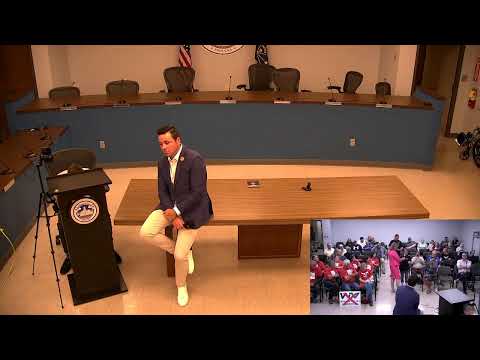
Lieutenant Governor Micah Beckwith said he opposes using eminent domain to force carbon sequestration projects on reluctant landowners and pledged to have his team press state regulators for details after residents described the proposed Wabash Valley Resources project and its possible effects on farmland and local water.
Lieutenant Governor Micah Beckwith said he opposes using eminent domain to force carbon sequestration projects on reluctant landowners and pledged to have his team press state regulators for details after residents described the proposed Wabash Valley Resources project and its possible effects on farmland and local water. "I'm a huge supporter of local control," Beckwith said, adding that he will "have our team look into that" and contact the Department of Natural Resources.
The issue came during a sustained public-comment block in which Susan, a farmer and resident of Vigo County, told Beckwith the company planned to inject "supercritical CO2" under local land and that state law had been altered to favor such projects. A teacher who identified herself as Whitney said she had raised concerns at Natural Resources Commission (NRC) hearings and said Wabash Valley Resources “only have to get 60% of their pore space voluntarily before they can use eminent domain to take the rest.” Whitney said she and other residents were not given clear answers at NRC or DNR meetings about how owners’ consent would be recorded and verified.
Residents and teachers told the lieutenant governor they fear a leak could endanger nearby elementary schools and groundwater. Whitney said a CO2 release in Mississippi persisted for about four hours in one incident and said the gas can be lethal in minutes for adults. Beckwith told the audience he shared their concerns about local control and eminent domain and said the state should ensure landowners receive fair market payment when condemnation is used. He also said he doubts carbon sequestration science: "I think it's nonsense science," he said, while suggesting ammonia and hydrogen production could be beneficial if not presented as CO2 sequestration.
Beckwith directed Anthony, a member of his staff, to gather information and contact DNR and NRC staff, offering to use the lieutenant governor’s office to press for transparency and verification of how pore-space consent and safety setbacks would be documented. He also said he would use his public platform to highlight residents’ concerns and support county efforts to assert local control.
Speakers urged clearer rulemaking and better notice to affected communities. Several speakers said legislation that enabled sequestration had been moved through the statehouse without adequate public input and that local governments had lost authority to require setbacks or safety plans. Beckwith told the crowd he would defend local control and promised to "be a watchdog" and to publicly oppose projects pushed through "under the cover of darkness."
Residents asked for specific steps: better documentation of how companies record voluntary pore-space agreements, engagement by school corporations on emergency plans, and more accessible DNR/NRC decision records. Beckwith said his team would attempt to obtain that information and urged residents to share materials with his staff.
The town hall produced no formal votes or regulatory changes; instead, Beckwith’s office committed to follow-up inquiries with DNR and NRC and to amplify residents’ questions to state decision-makers.