Get Full Government Meeting Transcripts, Videos, & Alerts Forever!
Get email alerts on the Right Of Way Management topic
No spam. Unsubscribe anytime.
Casa Grande studies right-of-way ordinance to tighten permitting, fees and restoration standards
Summary
City staff presented a study-session overview of a proposed right-of-way ordinance that would require permits for all work in public rights of way, establish pavement-cut fees, require as-built records for GIS, and set new restoration, bonding and notification standards; council signaled general support to continue drafting the ordinance.
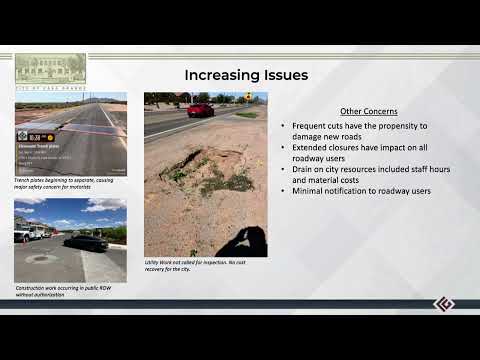
City of Casa Grande Public Works presenter Mac Harmon told the mayor and council on the study-session floor that staff is drafting a right-of-way ordinance to treat the public right of way “as an asset for the city” and to set clearer, enforceable rules for users. “The purpose of this presentation today is, kind of, to go over our right of way management and, kind of, how we treat the right of way as an asset for the city,” Harmon said. The ordinance under development would require a right-of-way occupancy permit for all work within the public right of way, create an open occupancy permit for franchise utilities, add separate permits for small temporary uses and special events, and set restoration, bonding and penalty provisions. The draft also proposes a pavement-cut fee schedule, standardized traffic-control and notification requirements, a holiday blackout schedule, and a requirement that as-built plans be submitted and recorded in the city’s GIS. Why it matters: Harmon said increasing utility and construction activity has raised the number of defective restorations, unpermitted work and safety issues the city must correct. He presented the pavement condition index concept (a 0–100 scale used to measure surface condition), and engineering consultant recommendations that informed proposed fee categories and a small probability factor (about 2 percent) for future trench rebuilding when calculating long-term costs. Harmon said the fee approach is intended to discourage cutting newly paved roads and to encourage less disruptive techniques. Key points from the study-session discussion - Permit scope and enforcement: Harmon said the current process relies on existing engineering staff and a single right-of-way permit that does not fit many non-utility uses. The draft ordinance would define multiple permit types and a clearer revocation, cease-and-desist and appeals process. Harmon said bonding or other securities would be required so the city can recover costs when contractors damage landscaping or infrastructure. - Fees and pavement cuts: Consultants Ryder Levitt Bucknole and geotechnical firm Nino and Moore helped craft a fee structure that bundles pavement maintenance, plan review, field inspection, third-party quality assurance, landscaping replacement and a probability factor for trench rebuilding. Harmon noted some costs—like business losses or mileage due to detours—are difficult to quantify and were not included in the fee table presented. - Operational and staffing changes: Staff suggested creating a dedicated right-of-way team or at minimum clarifying a single point of contact to coordinate utilities and contractors, citing current limits on the city’s three construction inspectors and rising permit volumes. - Notification and public communication: The draft would standardize who must be notified, when, and by what method. Harmon said the city will define what constitutes adequate notice (for example, door hangers versus social media posts) in the ordinance and related procedures. Council and staff remarks Council Member Edwards asked whether the ordinance would create onerous permitting for longstanding downtown events such as festivals and fairs; Harmon replied that fee schedules are still under consideration and that staff intends to create permit categories that are appropriate for temporary, non-construction uses. Council Member Dylan and others emphasized speeding up restoration timelines and holding developers or contractors accountable for prolonged closures. Council Member Huddleston asked whether the city would act as a repository for utility locations in GIS and whether the 811 (Call Before You Dig) process remains relevant; Harmon replied that utility owners remain responsible for their assets but that collecting certified as-built plans and recording them in the city GIS would help the city catch conflicts before construction starts and reduce unknown-utility discoveries in the field. Staff timeline and next steps City staff said they will continue drafting ordinance language, consult the city attorney and finance staff on bonding and fee implementation, and circulate the draft to utilities and contractors for comment. City Manager-level staff said the study session was a high-level overview and voiced support for moving forward; the department’s goal is to present a finalized draft for council consideration later (staff cited the objective of having a calendar-cycle implementation at the start of a new year as an optimal target, subject to legal and financial review). Context and background Harmon said staff sought input from local utility owners including Arizona Water Company and Southwest Gas and used consultant analysis from Ryder Levitt Bucknole and Nino and Moore to develop fee recommendations. Staff also proposed adopting a regional traffic-control standard (the Phoenix barricade manual) or creating a Casa Grande-specific version that would meet local conditions. Harmon emphasized the proposal is intended to protect public safety, extend pavement life and create predictable cost recovery rather than to block necessary utility work. Closing No formal motion or vote occurred; council and staff ended the study session with direction to continue drafting the ordinance and to return to the council with a proposed implementation schedule, fee recommendations and a public communication plan for further review.