Get Full Government Meeting Transcripts, Videos, & Alerts Forever!
Get email alerts on the Waste Discharge Permit Fund topic
No spam. Unsubscribe anytime.
State Water Board staff propose modest fee changes or use reserves to cover Waste Discharge Permit Fund shortfall
Summary
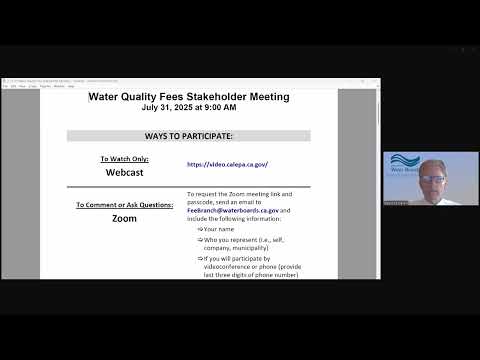
State Water Resources Control Board staff told stakeholders on a virtual meeting that the Waste Discharge Permit Fund enacted FY25–26 fee‑setting budget is about $197,000,000 and presented options to use reserves or adopt modest fee increases to cover projected shortfalls.
State Water Resources Control Board staff told stakeholders on a virtual meeting that the Waste Discharge Permit Fund (WDPF) enacted fee‑setting budget for fiscal year 2025–26 is about $197,000,000, down roughly $4,900,000 (2.5%) from the FY24–25 fee‑setting budget. Staff presented two high‑level options to address a projected gap between program budgets and forecast revenues: use a portion of the fund reserve with no fee changes, or adopt modest fee increases across several programs (roughly 2–3 percent) while drawing less from reserves.
Why this matters: the WDPF pays for permit programs that regulate discharge to state waters; small percentage changes can amount to real dollars for large permit holders, and the board must set fees consistent with the enacted budget before it begins billing.
Staff member Jackie Carter summarized the top‑line numbers, saying the FY24–25 fee‑setting budget was “about 202,000,000,” and the enacted FY25–26 fee‑setting budget is “about 197,000,000, reflecting a net difference decrease of 4,900,000.0 or 2.5%.” Division and branch staff then walked through program‑level projections showing a program budget total of roughly $196,800,000 and an anticipated revenue forecast of about $194,800,000, leaving a shortfall staff estimated at about $2.1 million for the coming year.
Program impacts described by staff: - The WDR program was shown needing roughly $1,200,000 to meet its budget (staff characterized this as roughly a 2.6% increase in fees for that program). - The 401 water quality certification program was noted as potentially needing an increase in the neighborhood of 3.3% based on recent demand and added workload from last year’s budget augmentations. - NPDES wastewater needs were characterized in staff slides at about a 2.7% gap. - Confined animal feeding operation (CAF), agricultural, and cannabis programs were not anticipated to need fee adjustments based on current projections.
Stormwater (municipal/industrial and construction sectors) showed a different pattern: staff said stormwater construction revenue is trending up, producing a potential surplus in that sector. Staff presented two policy options for stormwater construction fees: (1) a one‑time decrease to construction fees to rebalance the stormwater program, or (2) maintain current rates and monitor whether the uptick persists into a second year.
Fund reserve options and risks: staff reported an estimated WDPF ending reserve of about $22,900,000 (11.9%). They presented two scenarios: no fee changes and draw roughly $4.9 million of reserve (reducing reserve to about 9%), or adopt modest fee increases (2–3%) and draw roughly $2.8 million (leaving about 10% reserve). Staff warned that drawing reserves lower (toward a 5% target) without offsetting revenue would build a structural deficit; they estimated a structural deficit near $12,000,000 if reserves were driven to 5% without other changes.
Stakeholder questions and feedback: Sharon Green of the Los Angeles County Sanitation District emphasized that even small percent changes can equal “hundreds of thousands of dollars” across a large permit portfolio and urged staff to update stakeholders if the Legislature reopens the budget. Bob Gore, representing a utilities group, pressed for transparency on why program expenditures rose over prior years and asked staff to provide augmented handouts explaining multi‑year expenditure increases. Several stakeholders, including Noelle Kramer of the Wine Institute and James Garner of the Milk Producers Council, urged the board to consider holding fees flat given current economic conditions and the reserve level.
Timing and next steps: staff said they are required to set fees consistent with the enacted budget and will bring fee‑setting items to the board for consideration and possible adoption on Sept. 16; agenda items normally become public about 10 days before the meeting. Staff said they will continue stakeholder outreach and may adjust proposals if the Department of Finance and Legislature make further budget changes in the fall.
No formal board action was taken at the stakeholder meeting; staff will return proposals to the board for formal consideration on Sept. 16.