Get Full Government Meeting Transcripts, Videos, & Alerts Forever!
Get email alerts on the Safe Drinking Water Account Budget topic
No spam. Unsubscribe anytime.
State water board outlines $3.2 million increase to Safe Drinking Water Account, flags Monterey county primacy costs
Summary
State Water Resources Control Board staff told stakeholders the Safe Drinking Water Account fee-setting budget would rise about $3.2 million (6.7%) for FY25‑26, driven largely by legislative budget change proposals and a looming transfer of dozens of Monterey County small water systems back to the state.
State Water Resources Control Board staff told stakeholders Friday that the Safe Drinking Water Account fee‑setting budget for fiscal year 2025–26 shows a roughly $3.2 million increase, or about 6.7%, compared with the FY24–25 fee‑setting budget.
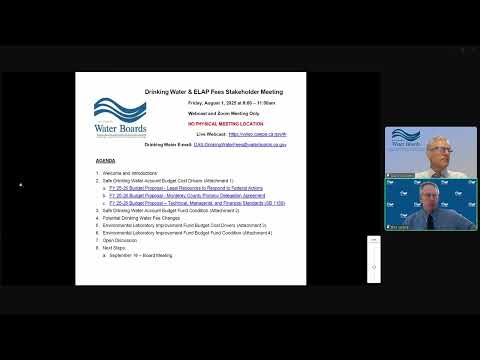
The increase is detailed in a staff presentation that identified several budget change proposals (BCPs) as the primary drivers. "The first table we're looking at shows last year's fiscal year 24 25 fee setting budget of just about 48,000,000, followed by the governor's inactive bud fee setting budget for fiscal year 25 26 at nearly 51,200,000.0, which is a net difference of 3,200,000.0 or 6.7%," Cassandra White, fee and revenue branch staff, said during the stakeholder meeting.
Why it matters: the additional spending pressure will affect whether the board proposes fee increases or draws on reserves. Stakeholders were shown two options: keep current fees and draw about $2.4 million from reserves (reducing the projected FY24–25 ending balance from about $8.3 million to roughly $6.0 million, or about an 11.5% reserve) or apply a uniform 5% fee increase to balance revenues and expenditures and retain an ending reserve of roughly $8.2 million (about 16%).
Staff emphasized the figures are being set against an unsettled statewide budget. John Russell, deputy director of division administrative services, warned the board is tracking state budget activity: "This budget year has been very dynamic and volatile. We're still anticipating some adjustments to the budget in the upcoming months," he said, and staff must set fees based on the enacted budget.
Budget change proposals described by staff include: - A reduction of $250,000 to an earlier legislative proposal tied to the Water Shutoff Protection Act (SB 3) that had been included in the FY24–25 enactment. - Legal resources to respond to federal actions: an interagency allocation to defend state environmental laws that results in a $200,000 Safe Drinking Water Account share for FY25–26. - A $2.7 million ongoing BCP tied to terminating the Monterey County local primacy delegation and returning regulation of approximately 284 small water systems to the state in September 2025. - A $925,000 ongoing BCP to implement technical, managerial, and financial standards required by SB 1188 (2024), including development work by the Division of Information Technology to augment the SAFER clearinghouse and move past-year data from the Electronic Annual Report (EAR).
Staff discussed the Monterey County primacy reversal at length during the open discussion. "Monterey County is a particularly hard hit. They are returning, over 200 water systems to us," a staff member said, explaining that counties have sometimes used their general funds to subsidize local primacy programs and that returns to state oversight can create a large one‑time workload and cost for the board. Staff estimated that a one‑time statewide transition if funded up front could have been on the order of several million dollars (staff said a prior estimate in 2020 was roughly $6.5 million and that inflation likely increased that figure).
Discussion versus decision: stakeholders were presented options and background; no board motion or fee adoption occurred at the meeting. Staff said the board will brief members and expects the item on the board agenda for the September 16 meeting, with the agenda packet posted 10 days prior. Staff also noted potential control section reductions from the May revise that appeared in draft materials but were not present in the enacted budget, and that Department of Finance guidance could prompt future adjustments.
The transcript and presentation materials provided to stakeholders include links to Department of Finance BCP pages for further detail; staff encouraged stakeholders to follow up with questions directly.
Ending: staff invited stakeholders to schedule follow‑up meetings to review the documents and flagged that unresolved state budget actions could change the fee recommendation ahead of the board briefing cycle.