Get Full Government Meeting Transcripts, Videos, & Alerts Forever!
Get email alerts on the Water Rights Fund Fee Options topic
No spam. Unsubscribe anytime.
State Water Board outlines fee options as water rights fund reserve falls under review
Summary
State Water Resources Control Board staff presented the water rights fund condition and two fee-path options — no-fee change using reserves or a 4–5% across-the-board increase — and described a separate Budget Change Proposal for legal resources and a $5.4 million loan tracked to support SGMA implementation.
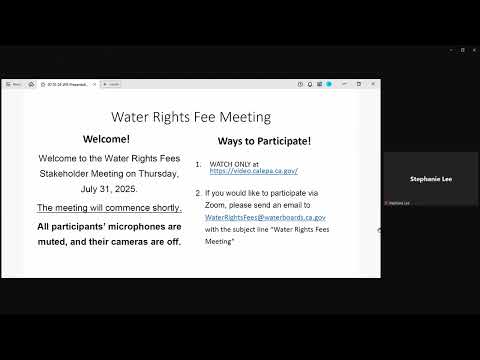
State Water Resources Control Board staff on July 30 presented two fee-setting options for the water rights fund and warned stakeholders that budget adjustments from the Department of Finance could change the numbers in the fall. The board ivision's fee and revenue branch chief, David Ciccarelli, said staff will propose a fee schedule for board consideration at a public meeting on Sept. 16.
The presentation laid out a projected fiscal-year 2024-25 ending balance of $9.8 million, about a 26% reserve, and two paths for 2025-26: no fee increases with about $2.5 million of reserves used (bringing the reserve to about $7.3 million, or roughly 19.6%), or an across-the-board fee increase of about 4% to 5% that would use roughly $840,000 of reserves and better align revenues with expenditures. "We're trying to do our best to lower [reserve] into a proper level," Ciccarelli said.
Staff detailed the net decrease in the fee-setting budget from $38.8 million (FY24-25 fee-setting) to $38.3 million in the enacted FY25-26 fee-setting budget, a $493,000 (1.3%) reduction. Jackie Carter, representing fee and revenue staff, listed primary cost drivers: state operations (a $249,000 decrease), pro rata costs (a $473,000 decrease), an increase of $29,000 for California Department of Tax and Fee Administration (CDTFA) processing costs, and a single BCP (Budget Change Proposal) of $200,000 for legal resources to respond to federal actions.
Cassandra White and David Ciccarelli explained the BCP in broader context: the California Environmental Protection Agency, the California Air Resources Board and the State Water Resources Control Board received $2.9 million across special funds to support 12 permanent positions in FY25-26 to respond to increased federal legal challenges. The water board's portion is $800,000 to support three permanent positions; the water rights fund's share of that amount is $200,000.
Staff also noted a $5.4 million loan from the Underground Storage Tank Cleanup Fund to the water rights fund that appears in the state's budget act and is being tracked as revenue for Sustainable Groundwater Management Act (SGMA) implementation. Ciccarelli emphasized that SGMA-related revenue and expenditures are accounted for separately within the water rights fund and that SGMA fee revenue cannot be used for water-rights activities, nor can water-rights fee revenue be used for SGMA activities.
The presentation flagged an accounting detail the branch is resolving: application fee revenue includes a nonrefundable initial review fee of $500 plus 10% of the applicable application fee for initial review, but statute limits refunds when an application is not accepted or is found defective under Water Code section 10062. Staff said they are reviewing application receipts to identify how much of the current reserve is composed of application revenue that may need to be refunded and plan to segregate that amount in future fund-condition reports.
Stakeholders asked questions during the session. Bob Gore of the Guoco Group, representing Kings River water-rights interests, recommended the no-fee-change option and observed, "That is quadruple the DOS recommended guideline for reserve fund," referring to the Department of State (DOS) guidance cited in his comment. No formal action was taken during the stakeholder meeting; staff said they will brief the board on stakeholder feedback and the items will be posted on the Sept. 16 board agenda at least 10 days prior to the meeting for public comment.
Staff recommended that stakeholders who want more detail or a private briefing contact the fee team; Ciccarelli and other staff named Jackie Carter, Cassandra White and John Russell as contacts. The board will consider adoption of fee schedules at the Sept. 16 public board meeting, where stakeholders can also comment during the meeting or in advance.