Get Full Government Meeting Transcripts, Videos, & Alerts Forever!
Get email alerts on the Animal Care Home Business topic
No spam. Unsubscribe anytime.
Commission holds dog‑boarding request after neighbors report attacks and noise; applicant offers limits
Summary
Planning commissioners held a request to run a home‑based dog‑boarding and training operation for 30 days after neighbors described fights, unattended dogs and continuous barking; the applicant said she is a licensed trainer and offered to accept only one paying board‑and‑train dog at a time.
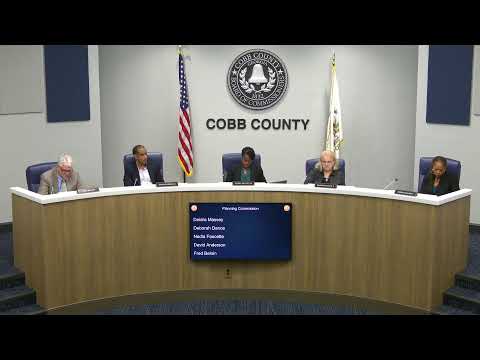
Cobb County planning commissioners on Thursday held (30 days) a temporary land‑use permit application from a dog trainer who operates a small board‑and‑train practice from her home, citing unresolved neighborhood complaints and conflicting accounts from neighbors and the applicant.
The case, filed as LUP 31 of 2025 for a property on Leafwood Drive, brought sharply divergent testimony. The applicant (identified in the hearing as Saint Luke Crispell) described herself as a professional dog trainer who works with a regional training company, holds a kennel license from the Georgia Department of Agriculture and limits in‑home board‑and‑train placements: ‘‘On most days, I only have one board‑and‑train dog. I’m lucky if I get two,’’ she told the commission. She said dogs are boarded inside the house, that she uses controlled exposure and stepwise socialization, and that many clients are friends or repeat customers. The applicant also said she is willing to make changes such as removing her Rover listing and restricting the number of paying board‑and‑train dogs.
Opponents described a different picture. Michelle Cuve, a neighbor who said she has a backyard view into the applicant’s patio, testified she has witnessed multiple violent dog fights, dogs left outside unattended in hot weather, and dogs wearing bark collars that shock them repeatedly. Another neighbor, Kerry Gilmore, said the business would ‘‘be a disaster’’ for nearby property values and described a history of barking and escapes; Christina Hopkins said the property’s small lot size and chain‑link fencing made the location unsuitable for the proposed use.
Staff recommendation and commission action: Planning staff recommended denial, describing the proposed commercial‑level boarding and overnight activity as too intensive for a residential neighborhood. Commissioners, however, decided to hold the matter for 30 days to allow time for additional fact‑finding and for the applicant and neighbors to meet. Several commissioners suggested mitigation options—visual buffering, schedule limits and a cap on simultaneous dogs—may be part of a compromise. During the hearing the applicant said she would agree to accept only one paying board‑and‑train dog at a time and to consider other specified operating limits.
Discussion vs. decision: No permit was granted. Commissioners directed staff to schedule a facilitated discussion between the applicant, immediate neighbors and district staff, and to return the case after inspections and any neighborhood‑level mitigation planning. If the applicant continues operating without a permit during the hold period, enforcement could be pursued by county code enforcement or animal control.
Next steps: The planning commission will revisit LUP 31 after a 30‑day hold. Commissioners urged both sides to discuss noise mitigation, screening and an agreed package of conditions that would allow limited in‑home training work while protecting neighbors.
Facts and figures: The applicant holds a Georgia Department of Agriculture kennel license (capacity referenced on license paperwork as up to 20 pets, though the applicant said she does not operate at that level); board‑and‑train placements are typically two weeks; the applicant said she most often houses one paid trainee at a time and has previously had up to six dogs on site (including family and friends’ dogs). Neighbors reported four people opposed and two supporters present at the hearing.