Get Full Government Meeting Transcripts, Videos, & Alerts Forever!
Get email alerts on the Wildlife Protection topic
No spam. Unsubscribe anytime.
Speakers, volunteer patrol warn council of sea turtle hatchling disorientation from beachfront lighting
Summary
Residents and a volunteer sea turtle monitor told the Jacksonville Beach City Council that artificial lighting along the oceanfront has caused multiple nesting failures and hatchling disorientation, and urged education and enforcement steps.
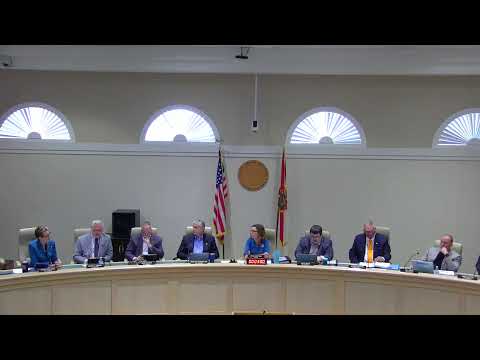
Council member Golding pressed the urgency of reducing beachfront light after residents and a volunteer monitor reported recent sea turtle nesting problems at the Aug. 4 Jacksonville Beach City Council meeting.
Kevin Brown, a volunteer and resident who identified his address as 1833 Kings Court, told the council the city is seeing “a light issue” and that the community recorded “56 false crawls,” meaning nesting females were disoriented and left without laying eggs. He said one nest moved “seven blocks parallel to the dune through two blowouts” and that hatchlings were found stranded in puddles.
The council heard that some businesses and utilities have adopted turtle-friendly lighting: Golding cited “4 Points by Sheraton, Best Western, and Margaritaville” and said Beaches Energy had replaced street lights with amber fixtures at some street ends. Brown said he had worked with the Florida Fish and Wildlife Conservation Commission to get permission to bring a volunteer on the beach and demonstrated a light-measurement instrument to show which lights are “not turtle friendly.”
Council members and staff discussed education as the first line of response. Golding said the city previously worked with Beaches Go Green to distribute informational materials to hotels and suggested reprinting or supplementing that outreach; she also noted the state sea-turtle license-plate grant program as a potential funding source for awareness campaigns.
No formal council action was taken. Council members and Brown characterized the problem as primarily one of education and voluntary compliance; Brown asked for continued council support and for the city to develop ideas to increase compliance with the city’s existing sea-turtle lighting ordinance.
The remarks came during council announcements and the public-comment portion of the meeting. No staff report, new local ordinance, or enforcement action was proposed or adopted at the meeting.
Council members asked staff to revisit outreach approaches and mentioned an upcoming social-media item (“take 2 Tuesday”) focused on sea turtles.
Community groups referenced in the discussion included Beaches Go Green and Beaches Sea Turtle Patrol. The Florida Fish and Wildlife Conservation Commission (FWC) was identified as the state agency that provided a limited operational accommodation (permission to take a volunteer in a cart for monitoring).