Get Full Government Meeting Transcripts, Videos, & Alerts Forever!
Get email alerts on the Water Supply And Infrastructure topic
No spam. Unsubscribe anytime.
Yucaipa Valley Water District outlines aquifer recovery, recycled-water plans and local industrial opportunity
Summary
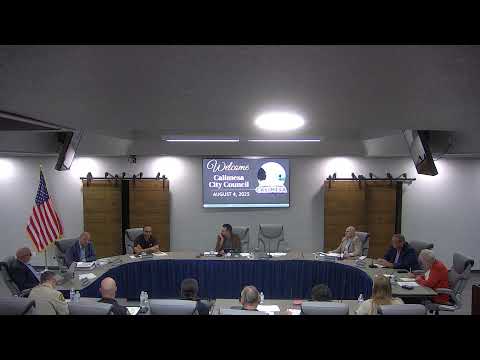
A Yucaipa Valley Water District presentation to the Calamasa City Council described multi-decade groundwater trends, the district's recycled-water and aquifer storage-and-recovery projects, and how those systems could support local industrial development and dual-plumbed housing in Calamasa.
Joe Zoba of the Yucaipa Valley Water District told the Calamasa City Council that the district has rebuilt groundwater levels in its basin and is moving to expand aquifer storage and recovery (ASR) and reused-water projects that could support local development. "Every new house that comes in is guaranteed a 20 year supply moving into the future," Zoba said, describing the district's policy of requiring a 20-year supply for new residential development.
Why it matters: Zoba framed the ASR and recycled-water work as both a supply-security measure and an economic-development tool. He said Calamasa and neighboring Yucaipa now have interconnected access to State Water Project deliveries and a growing recycled-water system, which the district uses to recharge aquifers and reduce groundwater production.
Key facts and claims: Zoba showed multi‑decade groundwater change charts for nearby basins and said Yucaipa Basin storage is roughly 10.75 billion gallons (about 33,000 acre-feet), which he characterized as about a three-year supply for the district. He said the district plans to inject about 820 million gallons into the ASR project and that about 1.63 billion gallons of State Water Project deliveries are dropped in the Yucaipa portion of the basin; the district can convey water between Yucaipa and Calamasa depending on purchase arrangements. He described Title 22 recycled water and the district's reverse-osmosis processes, and said the district is expanding reverse-osmosis treatment at its wastewater plant to produce very high-purity recycled water for injection and for dual-plumbed nonpotable service in new homes.
Council reaction and follow-up: Council members praised the facilities and the district's tour. Councilmember Cundiff called the facilities "very impressive" and thanked staff. Councilmember Manley said she sees construction activity from her back yard and said the project is already a neighborhood presence. Councilmember Garcia asked about jobs and hospital recruitment tied to the water infrastructure; Zoba identified potential industrial and health-care employers as examples of businesses that could benefit from reliable, high-purity water and accessible brine-disposal lines.
Caveats and limits: Zoba described technical details (membrane filtration, reverse osmosis, brine disposal) and operational tradeoffs; he noted the presence of faults that compartmentalize basins and the need to monitor thresholds to avoid spillover across those barriers. He also described differences among water types in a ranking exercise (ocean water, State Project water, drinking water, Title 22 recycled water, full RO recycled water) to illustrate relative contaminant loads; those illustrative rankings were presented as the speaker's analysis rather than as an adopted regulatory standard.
Next steps and public access: Zoba invited council members, staff and members of the public on facility tours and offered follow-up technical support for development questions. He said the district has purchased land for ASR and plans three injection wells along the freeway corridor; he warned that well drilling is a 24-hour activity and therefore visible to nearby residents. Zoba also noted the district's work to solar-power treatment facilities.
Attribution: All direct quotations and technical claims in this article are attributed to Joe Zoba, Yucaipa Valley Water District. Other reactions are attributed to council members identified on the record.