Get Full Government Meeting Transcripts, Videos, & Alerts Forever!
Get email alerts on the Resource Allocation topic
No spam. Unsubscribe anytime.
District staff outline state 'resource allocation' grant work to link spending to student outcomes
Summary
District staff described participation in a New York State resource allocation project aimed at linking financial data to student outcomes, highlighted data-system integration challenges, and recommended targeted interventions for low-performing subgroups.
District staff described a multi-month effort with a New York State resource allocation initiative designed to connect spending to student outcomes and to target resources at schools with low proficiency rates.
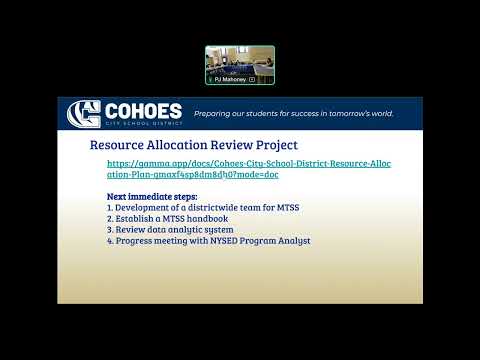
Tim Linedale (presenter) said the state invited districts to participate in a federally requested project and that the work aims to link budget flows from federal to state to district to building levels so principals can make more targeted spending decisions. He said the district identified data-connection problems: "we can't connect dollars to the student suburbs because our systems can't talk to 1 another," and recommended a merged data warehouse and reporting front end (the district is using Tableau) to filter expenditures by student subgroup.
Why it matters: Staff said the district's proficiency rates lag state averages and that per-pupil allocations differ by building in ways driven by staffing mixes (for example, differences in the number of self-contained special-education classrooms). The initiative aims to support equity by tracking per-pupil expenditures and intervention effectiveness.
Key points presented - Purpose of the project: Linedale said the framework's vision is "students for success in tomorrow's work," and the grant requires districts to identify priority dimensions such as financial allocation and targeted supports. - Data and systems: Staff reported that current financial, student demographic and assessment systems do not talk to one another and that the project includes building a merge into a district data warehouse and Tableau dashboards to report expenditures by student subgroup. - Evidence of need: Linedale reported gaps between district proficiency and state averages and cited subgroup disparities: "in the African American suburb, it's 23%" (transcript) and a reported gap of roughly 20 percentage points between a subgroup and the district average. He also said Regents exam performance trails the state by about 10 points (transcript phrasing approximate). - Local causes: Board members and staff discussed how staffing and teacher seniority affect per-pupil expenditure calculations; staff noted that smaller schools with multiple self-contained special-education classrooms show higher per-pupil costs because of staffing ratios.
Direction and next steps Staff said they expect to refine data codes and reporting with the vendor partner, to pilot merged reports before the school year, and to use pilot schools as models for districtwide rollout. The staff will present updated dashboards and a written narrative for board review in the coming weeks.
No formal board action on the grant or budget allocations occurred at the meeting; staff said they will return with specific reports and contract language for future board consideration.