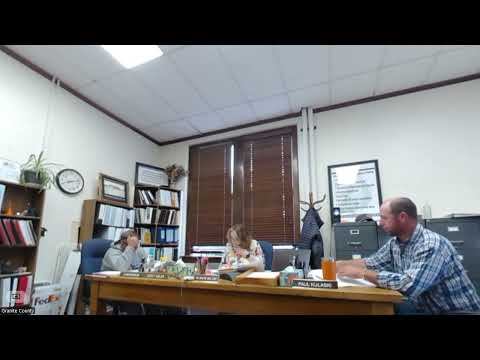
Granite County commissioners adjust road fund priorities, reserve funds and equipment plans
Loading...
Summary
Granite County commissioners and road department staff agreed this week to reconfigure the road fund budget for the coming fiscal year, shifting money between line items to cover a large jump in gravel and contracted services while holding travel and repairs near prior-year levels.
Granite County commissioners and road department staff agreed this week to reconfigure the road fund budget for the coming fiscal year, shifting money between line items to cover a large jump in gravel and contracted services while holding travel and repairs near prior-year levels.
County leaders said the changes respond to higher materials and rental costs and to one-time equipment needs identified by road staff. The commissioners kept repairs and maintenance at $100,000, set travel/fuel at $100,000, raised the roads and streets line to $200,000 and trimmed supplies to $40,000; they also earmarked roughly $20,000 toward capital outlay to help buy a belly-dump truck if the county elects not to lease. The county also confirmed roughly $11,003.95 remained in a prior LATCF capital line that could be applied to equipment purchases.
Why it matters: Road maintenance is the county’s most visible operating service and is sensitive to swings in fuel, gravel and rental-equipment prices. Commissioners said the larger roads-and-streets allocation reflects this year’s unusually heavy gravel purchases and more rental of compaction rollers and drums.
Most urgent facts: Road staff told commissioners they hauled about 13,000 cubic yards of gravel last year and expect about 15,000 this year; they also reported a single-year spike in purchase of large grader tires (a single set or pair recorded as roughly $12,000) and repeated rental of a compaction roller (five rental months in the fiscal year, about $6,500 per month). Road staff asked for $200,000 in the roads-and-streets line because last year the line ran roughly $91,768 over the originally budgeted $100,000.
Key details and context: Commissioners and staff discussed a short-term plan to cover rental costs (roller rentals and occasional leased belly-dump trucks) versus buying. The road office reported it had rented a belly-dump for about $13,600 for four months in a recent period and that one leased unit later broke beyond repair. Staff said the county has about $11,003.95 available in its LATCF outlay account that could be applied to an outright purchase if leaders choose to do so rather than continue to lease. Commissioners directed staff to prioritize short-term rentals where necessary but to aggressively explore used-equipment purchases for spring when a purchase would be less rushed.
Staff and commissioners also noted one-off costs that drove last year’s overruns: extended grader warranty premiums, extra roller/drum rentals during a concentrated paving season, and larger-than-expected gravel purchases after the county’s own pit supplies were reduced. Commissioners asked staff to monitor expenditures more frequently throughout the fiscal year so unexpected midyear purchases do not create large year-end shortfalls.
What the commissioners decided and next steps: By roll-call discussion the board agreed to the revised package that keeps repairs and travel at $100,000 each, sets roads and streets at $200,000, sets supplies at $40,000 and leaves a modest capital outlay allocation to pursue a belly dump purchase or lease depending on negotiated terms. Commissioners also asked staff to return with a detailed capital plan showing any tradeoffs and to catalog rental costs (roller/drum) as part of the other-purchased services line so future decisions are clearer.
Ending: The county’s road office will continue to operate under current service levels while staff and commissioners monitor fuel prices, gravel needs and equipment availability; staff said they will bring a refined capital proposal and a quarterly monitoring schedule to the board for the next quarterly review.