Get Full Government Meeting Transcripts, Videos, & Alerts Forever!
Get email alerts on the Traffic Calming Design topic
No spam. Unsubscribe anytime.
NDOT proposes speed cushions, radar signs for Mulberry Downs Circle after 85th-percentile speeds hit 47 mph
Summary
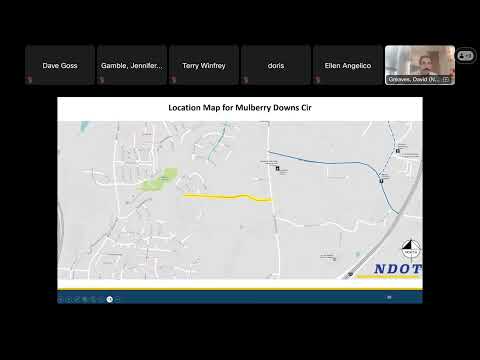
Nashville Department of Transportation staff presented a draft traffic calming plan for Mulberry Downs Circle on July 28 that would use speed cushions, radar-feedback signs and lane narrowing after on-street counts showed an 85th-percentile speed of 47 mph on a 30 mph street.
David Creams, an engineer with the Nashville Department of Transportation(NDOT), presented a draft traffic calming plan for Mulberry Downs Circle on July 28, 2025, proposing speed cushions, radar-feedback speed signs and lane narrowing after NDOT field counts showed an 85th-percentile speed of 47 mph on a street posted at 30 mph.
The proposal responds to safety concerns raised by residents who told NDOT they regularly observe high speeds on the stretch from Berrywood Way to Dickerson Pike. "With the speeds we're seeing, that checks out," Creams said, noting the project was selected in March 2025 from more than 600 applications and landed among the top 25 prioritized streets.
NDOT staff said the primary program goal is speed reduction because lower vehicle speeds reduce the severity of collisions involving pedestrians and cyclists. The draft design presented on the call includes four to five modular speed cushions (each about 3 inches tall), radar-feedback signs in the more wooded sections, and a restriping concept narrowing travel lanes to 10 feet to increase the buffer for cyclists and make drivers less comfortable at high speeds. Creams described speed cushions as the programmodular rubber devices bolted to the pavement that typically aim to reduce speeds to roughly 20to 25 mph at the cushion locations while allowing larger emergency vehicles to pass through gaps in the cushions.
Creams cited NDOTstudy results from March 2023 showing average speeds falling from 31 mph to 22 mph and the 85th-percentile speed dropping from 37 to 25 mph after vertical measures were installed on six prior projects. He said some locations are not suitable for vertical measures because of steep grades or tight curves; in those places NDOT sometimes installs radar-feedback signs instead.
Participants raised design questions during the meeting. A traffic engineer who joined the call and asked to share a screen suggested tightening lane striping where sidewalks/bike lanes serve as de facto pedestrian space and recommended evaluating stop-control or traffic circles at several intersections near the playground. Creams said stop control and crosswalks often fall outside the traffic calming programand will raise those requests with the paving and neighborhood teams to see whether they can be coordinated with the resurfacing schedule.
Design specifics discussed on the call included: - Measured traffic volumes under 1,000 vehicles per day for the corridor and pavement widths varying roughly between 30 and 37 feet along the length of the project. - Proposed vertical measures concentrated on the residential side of the loop, with radar-feedback signs proposed through the wooded, less-developed section. - Cushion spacing guidelines of roughly 300 to 500 feet, with NDOT staff estimating four cushions may avoid placing cushions directly on intersections; five cushions was the initial draft. - Speed cushion height of about 3 inches.
NDOT staff noted an adjacent specific-plan (SP) development on the north side of Mulberry Downs near Dickerson Pike will factor into final placement decisions. "I probably want to check where that driveway is going for the specific plan before we do that," Creams said. Residents also asked NDOT to consider whether lane narrowing or restriping could be an opportunity to add physical separation between cyclists and motor traffic; Creams said such changes are often part of sidewalk or resurfacing projects and that he would coordinate with other NDOT teams.
Creams closed by asking for further input via an online survey (engage.nashville.gov/trafficcalming) and said the recording of the meeting would be posted to Metro Nashville's traffic calming YouTube page. He said a field review and coordination with NDOT partners would follow, after which NDOT would produce construction plans and an online ballot for parcel owners whose properties touch the affected right of way.
Ending: NDOT recommended residents use the online survey and said staff will perform a site visit and follow up with homeowners and the HOA with refined plans prior to balloting.