Get Full Government Meeting Transcripts, Videos, & Alerts Forever!
Get email alerts on the Ethics topic
No spam. Unsubscribe anytime.
Council debates city ethics ordinance as complaints and legal costs mount
Summary
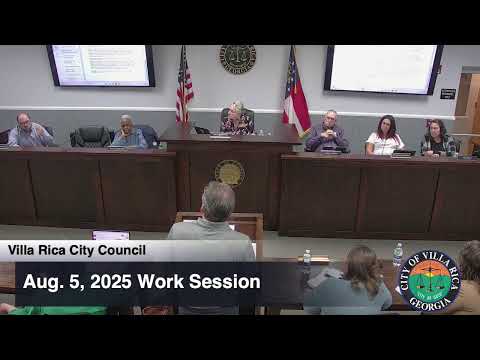
At an Aug. 5 work session, Villa Rica council members and staff debated the city's local ethics ordinance after multiple complaints and legal costs prompted calls to repeal or redesign the ordinance and to point citizens toward state and court remedies.
Mayor and council held an extended discussion Aug. 5 about the city's existing local ethics ordinance after staff and the city attorney provided guidance on alternatives for citizens who want to raise official-conduct concerns. City legal staff outlined options including criminal prosecutions for criminal violations, mandamus or declaratory-judgment actions in Carroll County Superior Court, petitions for review of judicial or quasi-judicial city actions, and complaints to the Georgia State Ethics Commission for campaign-finance matters.
Why it matters: The council said the current local ordinance has produced multiple complaints, cost the city legal fees and administrative resources, and nonetheless provides limited remedial authority or enforcement options. Council members asked whether keeping, repealing or replacing the ordinance is the best path forward.
City staff and council members said the local ethics ordinance does not allow the city to impose corrective or punitive legal remedies and that many complaints the city has processed were dismissed or deemed outside the ordinance's jurisdiction. Council members repeatedly raised the cost to taxpayers, with a headline figure cited in discussion of roughly $10,000 in legal fees so far related to enforcing or processing ethics complaints; staff said those legal costs include attorney time and administrative staff time to convene meetings and process records.
Options discussed: The city attorney's memo (summarized at the meeting) listed nonexhaustive alternatives: criminal investigation and prosecution by law enforcement and the district attorney when a criminal statute may have been violated; mandamus actions in Superior Court when a public official refuses to perform required duties; declaratory-judgment actions to challenge improper public actions; complaints to the Georgia State Ethics Commission for campaign-finance violations; and petitions for review of governing-board decisions in Superior Court. Council members debated whether a filing fee for local ethics complaints could recoup some costs and whether it would discourage meritorious filers; staff said the legal effect of charging a local filing fee had not been researched.
Some council members argued for outright repeal of the current ordinance because it can be used for repeated filings that consume city resources yet provide little legal remedy, while other councilmembers favored keeping an accessible city-level option for citizens who want to raise concerns before pursuing costlier court filings. Council consensus was not reached; the item will return to council for future action and the city manager indicated staff would prepare options, including how to direct citizens to existing venues such as the state ethics commission and the courts.
What was said about alternatives: Council members noted the state ethics commission will accept campaign-finance complaints for free online but that other legal options (mandamus, declaratory judgment, petition for review, criminal complaint) can require litigation and associated filing fees or attorney representation. Several councilmembers recommended exploring a filing fee with waiver options for those who cannot afford it, while others said imposing a fee risks deterring legitimate complaints and still would not guarantee a remedy. Some members urged staff to produce an informational guide to existing legal options citizens can use outside the local ordinance.
The council asked staff to return with a recommended approach. In public discussion, the mayor and members emphasized balancing transparency and access to complaint mechanisms with limiting frivolous filings and protecting taxpayer resources.