Get Full Government Meeting Transcripts, Videos, & Alerts Forever!
Get email alerts on the Water Infrastructure topic
No spam. Unsubscribe anytime.
Mayfield Heights approves agreements to join Cleveland Water suburban main renewal program
Summary
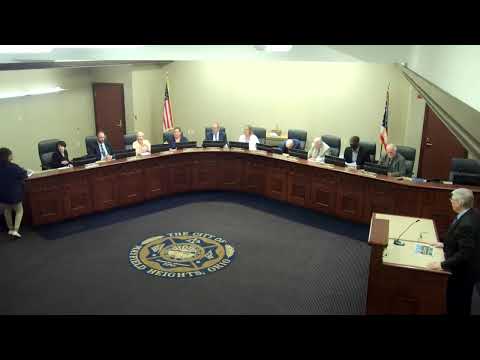
Mayfield Heights council voted Aug. 4 to authorize the mayor to execute three agreements with the City of Cleveland that would transfer ownership of local distribution mains to Cleveland and make the city eligible for Cleveland Water's suburban main replacement funding.
Mayfield Heights council on Aug. 4 approved a resolution authorizing the mayor to sign an asset-transfer agreement, a municipal-utility (economic development) agreement and a restated water service agreement with the City of Cleveland that would make the city eligible for Cleveland Water's suburban water-main renewal program.
The move would transfer ownership of Mayfield Heights' distribution mains (16 inches and smaller) to Cleveland Water and let Cleveland assume responsibility for capital replacements on those mains, Cleveland Division of Water Commissioner Alex Margavicious said. "If you execute, you will sign a new agreement called the restated agreement. It is for a minimum of 20 years," Margavicious told the council during a Committee of the Whole presentation.
The program matters to taxpayers and public safety because Mayfield Heights has 49 miles of water main and, according to Cleveland Water's presentation, nearly 22 miles of pipe date from the 1920s. Margavicious said the current market replacement cost is about $2 million per mile, creating a potential $43 million replacement obligation if the city were to fund all of that work on its own.
Cleveland Water described five written elements that come with the restated agreement: the restated water service agreement itself, an economic-development/municipal-utility-district agreement, an asset-transfer agreement, participation in Cleveland's suburban replacement program and a reimbursement agreement. Margavicious said the written restatement preserves most of the earlier agreement's language but adds clarifications on incentives and on responsibilities for hydrant maintenance, lead-line removal and project reimbursement.
Under the economic-development component, real-estate tax abatements would be limited (to 75% or less and no more than 10 years), and income-tax abatements would be prohibited. The restated agreement also includes a five-year tax-sharing provision if a business moves from one signatory community to another: "If that occurs," Margavicious said, "whichever way it goes, the agreement says for the next 5 years that the gaining community remits half of the new income taxes back to the losing community." After five years the gaining community keeps 100% going forward.
Cleveland Water described how projects are selected: each participating municipality may nominate streets twice a year; a technical committee of suburban and Cleveland engineers scores nominations using seven technical criteria: historical main-break rate, acceleration in recent breaks (five-year window), fire-flow deficit, recurring water-quality problems, coordination with new pavement, transmission-main (spillover) benefits and lead-service-line removal. Margavicious said the committee deliberately avoids demographic factors.
Cleveland Water also explained funding mechanics. Communities typically design the water work, let the construction contract and submit bids; Cleveland Water then reimburses design, construction and construction-administration costs and provides a contingency (usually 10%) up front. Margavicious said the formal legal commitment in the agreements obligates Cleveland Water to spend $10 million a year; the utility had voluntarily increased that to more than $15 million, $16 million in the current year and a planned $17 million next year, with the possibility of further increases.
Mayfield Heights' city engineer, Nick Feeney, told council the city submitted two projects to Cleveland Water before the meeting. He said the Marnell application totaled $815,001.15 for the water portion (design, construction, administration). He said the Washington application totaled roughly $1.0 million (the engineer's figure presented in the meeting transcript was $1,000,004.62). Feeney cautioned that Cleveland's scoring is numerical and competitive and that submitting does not guarantee an award; Cleveland Water expects to announce awards in early September.
Council members and staff raised questions about timing, scoring, appeals and how the program affects the city's existing incentive policies. Several council members said the $500,000 payroll threshold used in the economic-development language looked low and would capture relatively small employers. Economic-development advisor Jeremy (surname not given in the transcript) told council the threshold is the same language used by the other 40-plus suburbs that have signed the agreement and that the provision dates to the original 2007 negotiation among suburban law directors.
Council discussed how the agreement limits use of Mayfield Heights' current tax-incentive programs when the applicant company previously was located in the City of Cleveland. Jeremy told council that, if a qualifying business moved from Cleveland to Mayfield Heights, the city likely would have to provide upfront incentives and that tax-sharing payments to a losing community would push much of any new income-tax revenue into that sharing period for as long as five years.
Fire and public-works staff emphasized a public-safety element: Chief Elliott (identified in the meeting as "Chief Elliott") told council Mayfield Heights has hydrants and mains from the 1920s, recurring main breaks and recorded areas with reduced fire flows, and urged the council to seek options for accelerated capital replacement.
Council approved the resolution authorizing the mayor to execute the agreements (Resolution 2025-40). The motion to approve was moved by Councilmember Maddock and seconded by Councilmember Simeda; a roll call vote for the approval showed the motion adopted. Council members who voted in favor included Medic, Minor, Cebeda, Talvin, Balestreya, Manno (voted yes with qualification), and Snyder.
What comes next: Cleveland Water will score the submitted projects and announce awards in early September. If a Mayfield Heights project is selected, the city can either have Cleveland Water design and construct the work or contract it and be reimbursed. If the city later reclaims ownership of mains, the agreements allow the city to revert to its prior water-service agreement with five years' notice and prorated repayment to Cleveland for any capital reinvestment the utility made.
Speakers quoted in this article spoke during the Aug. 4 Committee of the Whole meeting and are listed in the article's speaker section.