Get Full Government Meeting Transcripts, Videos, & Alerts Forever!
Get email alerts on the Water Infrastructure topic
No spam. Unsubscribe anytime.
Mayfield Heights Council Authorizes Agreements to Join Cleveland Water suburban main renewal program
Summary
After a presentation by Cleveland Water officials, Mayfield Heights approved a resolution authorizing the mayor to sign three agreements that would transfer ownership of local distribution mains to the City of Cleveland and make the city eligible to participate in Cleveland Water’s suburban water main renewal program.
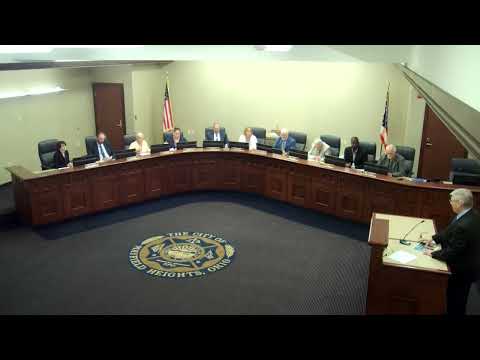
Mayfield Heights on Aug. 4 approved a resolution authorizing the mayor to execute three agreements with Cleveland Water that would make the city eligible for the utility’s suburban water main renewal program. The agreements include a restated water service agreement, an economic development (municipal utility district) agreement, and an asset transfer agreement transferring ownership of local distribution mains (16-inch and smaller) to Cleveland Water.
The vote follows a presentation by Alex Margavicious, identified in the meeting as Cleveland Water Division commissioner, who described the program’s structure and scoring criteria. Margavicious said the restated agreement has a minimum 20-year term and automatically renews thereafter; a municipality may revert to its prior agreement if it gives Cleveland five years’ advance notice, but must reimburse Cleveland on a prorated basis for any capital reinvestment the utility made in the intervening period. “If you execute, you will sign a new agreement called the restated agreement. It is for a minimum of 20 years,” Margavicious told council members.
Why it matters: Cleveland Water says the program has funded nearly 500 projects and reinvested roughly $243 million in suburban mains to date; proponents at the meeting said the program allows Cleveland to undertake capital replacement on smaller suburban mains it previously could only repair. Members of council and city staff pressed Cleveland and the city’s engineer about selection criteria, timing, cost exposure and the effect the agreement would have on local economic-development incentives.
Most important facts - Program elements: restated water service agreement, municipal utility (economic development) agreement, asset transfer agreement, suburban water main replacement and reimbursement agreements. The restated water service agreement runs at least 20 years; reversion requires five years’ notice and prorated repayment for Cleveland’s capital investment. - Scoring criteria: Cleveland uses seven technical criteria to prioritize projects, led by main-break rate and recent break trends, plus fire-flow deficit, recurring water-quality problems, coordination with pavement work, transmission-main (spillover) benefits and lead-service-line removal. Applications are scored twice yearly (fall and spring). - Funding and scale: Cleveland reports 497 projects and $243 million committed to date. Cleveland’s legal minimum annual contribution in the agreement is $10 million; the utility has voluntarily increased its annual program spending and discussed rising its commitment to roughly $16–17 million this year with the possibility of further increases. - Local scale and cost: Mayfield Heights has about 49 miles of water pipe; meeting testimony said roughly 22 miles were installed before 1930. At an estimated $2 million per mile for full main replacement, the city faces roughly $43 million in replacement cost if done independently, according to Cleveland Water’s presentation. - Application examples: City engineer Nick (presenting the city’s submissions) said Mayfield Heights submitted two applications: Marnell Street — $815,001.15 (construction and administration) — and Washington Street — approximately $1,000,004.62 (design, construction estimate and administration). Funding is competitive and numerically scored; Cleveland will post funding decisions in early September for the fall cycle if applications are complete.
Questions and caveats discussed at the meeting Council members asked how coordinated street projects affect scoring, whether the scoring can be appealed, and how the agreement would restrict local incentives. Margavicious said the scoring is intended to be technical and that there is no formal applicant appeal process; he said Cleveland and a suburban council of governments jointly developed the technical criteria.
Economic-development limits in the companion agreement drew sustained attention. The agreement limits certain incentives between signatory communities: real-estate tax abatements are limited to 75 percent or less and no more than 10 years; income-tax abatements are prohibited. Margavicious described a five-year tax-sharing remedy if a business relocates between signatories: “If that occurs, whichever way it goes, the agreement says for the next five years that the gaining community remits half of the new income taxes back to the losing community,” he said. City economic-development staff and council members voiced concern that the income-tax restriction could complicate the city’s existing pre-1994 CRA (100% real-estate tax abatement for new construction) and a local job-creation grant program.
Public-safety and implementation concerns Fire Chief Elliott, speaking from the council dais, pressed the council to weigh public-safety risks of deferred capital replacement. “We have areas in this city that have reduced fire flows… we're sending guys in burning buildings for a street that could pop a hydrant, pop a main,” he said, urging action either through the Cleveland program or by budgeting for local replacement.
Council action and next steps Council passed Resolution 2025-40 authorizing the mayor to execute the three agreements. The motion to approve was moved and seconded at the special meeting; the roll call vote recorded the mayor and councilmembers voting to adopt the resolution. If the city executes the agreements, staff may nominate streets for the fall or spring scoring cycles; design and construction remain under municipal control if the city elects to lead the contract, and Cleveland will reimburse approved costs after bid review and verification of a competitive procurement.
What remains unclear or contingent - Funding is competitive: submission does not guarantee award; Cleveland’s scoring and the pool of applicants determine which projects are funded each cycle. - Local incentive effects: council and economic-development staff flagged potential future conflicts between the agreement’s incentive limits and the city’s existing programs; the transcript records discussion but no amendment to local incentive policies. - Lead-service-line removal: Cleveland referenced a federal target that all lead service lines be removed by 2037; the transcript notes lead removal is a scoring criterion but Cleveland cautioned meeting attendees that complete removal across large areas is constrained by deadlines and funding.
Ending Councilmembers and staff said they would continue to evaluate the trade-offs—competitive funding of main replacement and reduced municipal capital burden versus limits on local economic incentives and a long minimum contract term—before selecting which streets to nominate in future cycles. The city’s engineer and Cleveland Water encouraged municipalities to coordinate street resurfacing and mains replacement to maximize scoring and reduce restoration costs.