Trust claims manager urges local governments to file notice-of-claim forms and update state database
Loading...
Summary
Jeff Rowley, claims manager at the Utah Local Governments Trust, reviewed the Utah Governmental Immunity Act, explained the notice-of-claim requirement and a new statutory duty to file designated-agent information with the state database, and urged members to preserve evidence and notify the trust promptly after incidents.
Jeff Rowley, claims manager at the Utah Local Governments Trust, told a membership webinar that local governments should file notice-of-claim forms promptly, preserve evidence at incident scenes and update their designated-agent information on the state database after a legislative change to the notice-of-claim process.
Rowley said the notice-of-claim requirement is a threshold procedural step under the Utah Governmental Immunity Act that a claimant must meet before a district court will have jurisdiction to hear a lawsuit. "Any person having a claim against the governmental entity . . . shall file a written notice of claim with the entity before maintaining an action," Rowley said, quoting the statute's procedural requirement and explaining why compliance matters.
The notice-of-claim rule matters because it gives public authorities a chance to investigate and, where appropriate, settle claims before costly litigation. Rowley said the trust's best practice is to give claimants a notice-of-claim form at the scene when appropriate and to forward any returned notices immediately to the trust so claims professionals can begin their work.
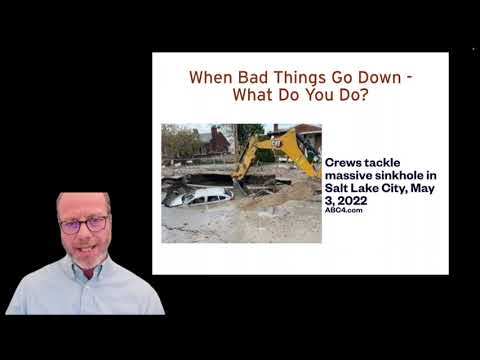
Rowley summarized key operational points for incident response: make the scene safe, document facts with photos and videos, preserve physical evidence such as a failed pipe or damaged vehicle, and follow agency policies on who may speak with claimants and the public. "Take lots of photos. Take lots of videos," Rowley said. He warned that destroying evidence can give rise to a spoliation inference in later litigation.
He also reviewed substantive protections in the Utah Governmental Immunity Act, noting the law limits when claimants can prevail and caps damages. Rowley recited current caps used under the act: a single-person injury cap of $911,300, a per-occurrence cap of $3,668,400 when multiple people are injured, and a property-damage cap of $366,900. He cautioned that those protections apply to state-law claims and do not displace federal claims such as civil-rights actions under federal law.
Rowley told members the trust contracts with Constitution State Services, a division of Travelers, to handle day-to-day claim management, while the trust remains the party that pays claims. He described the trust's internal claim workflow: a claims professional is typically assigned the same day a claim is filed and is expected to contact the entity and, when appropriate, the claimant within one business day.
A statutory change discussed at the webinar added a new filing requirement for governmental entities. Citing Senate Bill 169, Rowley explained that each governmental entity must now file a statement with the Department of Commerce identifying any doing-business-as name, the office and agent designated to receive a summons and complaint, and the physical address for service. He warned that failure to maintain an entry on the state Governmental Immunity Act database can forfeit procedural protections: "If public entities don't comply with this law, don't have this statement up there, then they can't complain when a lawsuit is filed that it was untimely or that the notice of claim wasn't done correctly," Rowley said.
Rowley gave practical instructions: create or adopt a notice-of-claim form that contains the statutory elements, put the entity's name and designated recipient on the form, distribute it to individuals (not to opposing counsel or insurers), and email returned notices to the trust so staff can enter claims into the system. He said notices can be hand delivered, mailed or emailed, but an emailed notice must be sent to the designated clerk/recorder and to the entity's attorney to comply with the statutory email rule.
During a brief question-and-answer exchange, an attendee named Patrick asked whether a fatality changes the process. Rowley replied that while sympathy is appropriate, the substantive response is similar but requires thorough fact gathering before settlement decisions. Another attendee raised playgrounds and flood risk as concerns. Jason, a loss-prevention staff member with the trust, added that a fatality "puts an exclamation point on the process," stressing urgency in such cases.
Rowley closed by urging members to notify the trust early on major incidents — fires, large sewer or water backups or multi-vehicle crashes — and to use the trust's legal hotline for legal questions. "Get claims into us right away," he said, "Call the trust legal hotline or call me if you just don't know what to happen."