Get Full Government Meeting Transcripts, Videos, & Alerts Forever!
Get email alerts on the Prevailing Wage topic
No spam. Unsubscribe anytime.
Bloomington council tables debate on prevailing‑wage ordinance changes after hours of testimony
Summary
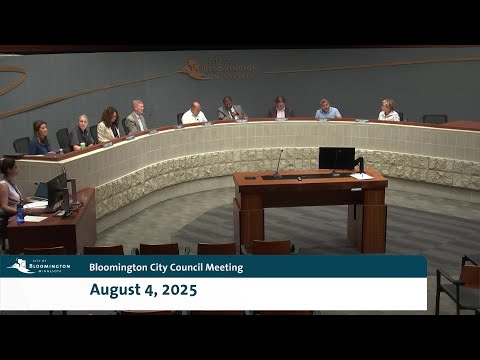
After a public hearing and nearly three hours of testimony on Aug. 4, 2025, the Bloomington City Council voted to table proposed policy changes to its prevailing‑wage ordinance and instead postpone further action to allow more stakeholder work and staff follow‑up.
Bloomington — The City Council on Monday tabled indefinitely a set of proposed changes to the city's prevailing‑wage ordinance after a public hearing that drew union representatives, policy researchers and developers.
Sarah Abe, Bloomington Housing and Redevelopment Authority administrator, told the council the city's prevailing‑wage ordinance was adopted on June 17, 2024, and applies to projects in which the city, HRA or port provides funding when a total project cost exceeds $175,000. Staff presented five proposed changes that included administrative clarifications and two broader policy options: an explicit waiver process for individual projects and expanding the small‑project exemption from the Davis‑Bacon standard of 8 units up to 20 units.
The ordinance proposal would clarify that pass‑through and conduit bond funding are exempt, add an explicit rule‑making authority for administration, and offer a two‑step test for any waiver that would require (1) consistency with the comprehensive plan and demonstrated financial infeasibility and (2) at least one additional showing such as prior failed development attempts, a site vacant for five years, or a unique hardship.
Why it matters: Bloomington's prevailing‑wage rules affect any development that receives public assistance and crosses the $175,000 project‑cost threshold. Supporters of the existing ordinance said it protects workers from wage theft and levels the playing field for legitimate contractors; opponents urged flexibility for hard‑to‑develop sites and small projects.
Speakers at the public hearing urged opposing outcomes on starkly different grounds. Lucas Franco, research manager for a construction union representing workers in Minnesota and North Dakota, said, “we can't try to solve our housing crisis on the backs of vulnerable workers.” Jake Schweitzer of North Star Policy Action and other speakers presented research and examples purporting to show widespread wage theft and argued exemptions would reward developers who undercut labor standards. Representatives of the developer seeking relief at a site in Bloomington provided pro forma materials to staff and said remediation and site conditions drive their economics; Kevin Knaes of the Port Authority said staff had reviewed the developer's pro forma and remediation estimates.
Council debate focused on process and scope rather than the general principle of protecting workers. Several council members said they were not satisfied with the outreach and level of stakeholder engagement before the proposal was presented and expressed concern about giving staff broad rule‑making authority without clearer guardrails. Council member D'Alessandro offered a motion to approve the administrative clarifications while removing the policy provisions (the 20‑unit exemption and the waiver language). That motion failed on a 3–3 vote. Council member Lohmann then moved to table the item indefinitely and direct staff to return with alternatives and additional stakeholder work; the motion carried 4–2 (D'Alessandro and Mayor Tim Bussey opposed).
Formal actions taken at the meeting: - The council closed the public hearing on item 4.1 by motion (motion by Council member Lohmann, second by Council member Rivas). The hearing closed without immediate council action. - A motion by Council member D'Alessandro to adopt the administrative amendments while excluding the waiver provision (23.36(c)) and the 20‑unit exemption (23.36(d)) failed 3–3. - Council member Lohmann moved to table the entire item indefinitely and direct staff to bring back alternatives; second by Council member Rivas. Motion passed 4–2.
What was discussed and not decided: Staff presented administrative items staff said would clarify existing practice (for example, confirming that federal Davis‑Bacon small‑project exemptions apply and explicitly exempting pass‑through and conduit bond funds). The council did not adopt the policy changes — the waiver procedure or the proposed expansion of the exemption to projects of 20 units or fewer — and did not change the effective threshold ($175,000) announced in the 2024 ordinance. Council members and commenters asked staff to return with more analysis on how many projects could qualify for waivers, what documentation would be required, and what contractual protections (affidavits, payroll audits, complaint channels) could be required where a waiver might be granted.
Next steps: The item is tabled indefinitely. Council directed staff to continue stakeholder engagement — including labor groups, developers and the HRA/port — and to return with options and additional analysis. If council later adopts amendments, staff said the ordinance changes would be posted per statutory notice and would be effective 10 days after posting, and any administrative rules would be effective 30 days after publication if rulemaking authority is granted.
Context and balance: Union and labor‑aligned groups urged the council to reject policy exemptions, saying prevailing wage prevents wage theft and does not materially increase project costs when contractors play by the rules. Several research presenters and a compliance monitor described historical and recent examples of subcontractor wage theft tied to projects where prevailing wage was not required. Developers and port authority staff said remediation and site conditions can make particular projects economically marginal and provided pro forma estimates to the city for staff review. Council members repeatedly separated administrative clarifications from policy changes and expressed concern about adopting broad new waiver authority without a detailed, public standard and stronger outreach to affected parties.
For now, the ordinance remains as adopted in June 2024; the council will consider further changes only after additional staff analysis and wider stakeholder consultation.